
High Cholesterol in North Carolina - Fact Sheet
What is cholesterol?
Cholesterol is a waxy fat-like substance found in the blood stream. Blood cholesterol is made by the liver. Dietary cholesterol is found in animal foods such as fatty meats, eggs, butter, cheese, and milk.
- Cholesterol is carried in the blood by proteins called lipoproteins. The two types of lipoproteins are:
High Density Lipoprotein (HDL) - known as “good” cholesterol
Low Density Lipoprotein (LDL) - known as “bad” cholesterol - Too much LDL (bad cholesterol) in the blood builds up plaque in the arteries. This plaque can reduce blood flow through arteries and can cause heart disease or stroke.
- Knowing the level of cholesterol helps to understand the degree of risk of heart disease and stroke, which are leading causes of death in the nation.
How many people are affected by high cholesterol?
- An estimated 86 million (36.3%) NC adults reported being told by a health professional that they have high blood cholesterol.1,2
- In NC in 2022 cholesterol was the primary cause of 768 Deaths (ICD 10 code E78)
- a contributing cause to 4,716 atherosclerotic heart disease deaths.3 (ICD 10 Code I25.10)
What are the symptoms of high cholesterol?
- Cholesterol has no symptoms; therefore, many people are unaware that they have high cholesterol. It is important that people regularly get their cholesterol checked.
What are the risk factors for heart disease?
- Behaviors that increase risk for high cholesterol include eating a diet with high amounts of saturated fat and trans-fat, physical inactivity, excessive alcohol consumption, and smoking.
- Other risk factors include a family history of high blood cholesterol, type 2 diabetes, obesity, age, race and ethnicity, and sex.
Figure 1: Prevalence of risk factors for high cholesterol in North Carolina adults 18 and older
- Fruit, Vegetables, or Beans (less than 5+ servings a day) - 89.2%
- Overweight and Obese - 68.69%
- Did not meet Physical Activity Recommendations - 40.10%
- Current Smoker - 12.40%
Source: 2023 and 2021 NC Behavioral Risk Factor Surveillance System (BRFSS) Survey Results4
How is high blood cholesterol diagnosed?
- A simple blood test called a “lipid profile” detects high cholesterol. Cholesterol levels are measured in milligrams (mg) of cholesterol per deciliter (dL) of blood. A total cholesterol level lower than 200 mg/dL is considered a desirable level and more than 200 mg/dL is considered high.5
- Most adults should have cholesterol checked every 4 to 6 years, however adults with heart disease, diabetes, or a family history of high cholesterol should get checked more frequently. Children and adolescents should have cholesterol checked occasionally, check with your child’s healthcare provider. In 2023, 91.5% of North Carolina adults reported that they had their blood cholesterol checked within the last five years and 79.4% checked within the past 12 months.2
Cholesterol levels
- Desirable - Less than 200 mg/dL
- Borderline high - 200–239 mg/dL
- High - 240 mg/dL and above
What are the complications of high cholesterol?
- High cholesterol levels lead to atherosclerosis, a condition where the arteries become narrow and reduce blood flow due to buildup of plaque. Over time, uncontrolled high cholesterol can cause cardiovascular disease, heart attacks and stroke.
What are the treatment options for high cholesterol?
- High cholesterol is typically managed by making lifestyle changes such as choosing foods lowering in saturated and trans fats and increasing physical activity and taking cholesterol-lowering medications prescribed by your healthcare provider.
- Take medications as directed.
- Check cholesterol levels regularly.6
How can high cholesterol be prevented?
Healthy lifestyle practices can reduce the risk of high cholesterol, these include:
- Maintaining a healthy diet. Reduce saturated fat, trans fats, sodium and added sugars, and eat foods rich in omega-3 fatty acids and fiber. See eatsmartmovemorenc.com, medinsteadofmeds.com
- Maintaining a healthy weight or losing weight (for those who are overweight or obese). See esmmweighless.com.
- Engaging in regular physical activity. See eatsmartmovemorenc.com, esmmweighless.com.
- Avoiding tobacco products and secondhand smoke for non-smokers and quitting for current smokers. For general information about smoking and how to get help quitting, please visit quitlinenc.com or call 1-800-QUIT-NOW (1-800-784-8669).
- Limiting alcohol consumption. Men should have no more than two drinks per day, and women should have no more than one. For more information, visitcdc.gov/alcohol.
- Working with your health care team to manage diabetes. For information on diabetes, please visit DiabetesNC.com.
Disparities, inequality and inequity in the burden of high cholesterol
- North Carolina has the 20th highest prevalence of diagnosed high cholesterol among the 48 states with data (data missing for Kentucky, Pennsylvania and Washington, D.C.).7
- In NC, non-Hispanic White adults (38.2%) and non-Hispanic Black adults (38.9%) are more likely to have been diagnosed with high cholesterol compared to non-Hispanic other (25.3%) and Hispanic adults (25.0%).2
- Among NC adults the prevalence of high cholesterol generally increases as education level and household income decreases. Moreover, the prevalence considerably increases with age. For example, the prevalence increases from 28.1% to 38.9% as the age group increases from 35-44 to 45-54.2
- Women over age 55 often have higher rates of cholesterol due to hormonal changes because of menopause.8
- There is geographic variation in the prevalence of high cholesterol rates; the southern and northwestern parts of the states have a higher burden (Figure 2).
- North Carolina adults who reside in the most distressed counties are more likely to have been diagnosed with high blood cholesterol (38.7%) compared to adults who reside in the least distressed counties (33.6%) according to the NC Dept. of Commerce County Tier Classification.2,9 County distress is an indicator made up of unemployment rates, median household income, population growth, and adjusted property tax base.
Figure 2. High Cholesterol Rates for Adults 18+ in North Carolina, and NC Department of Commerce County Distress Rankings
Need map data as csv to create map, or link to outside source. Since this is made up of two sets of data overlayed, it may not work here.
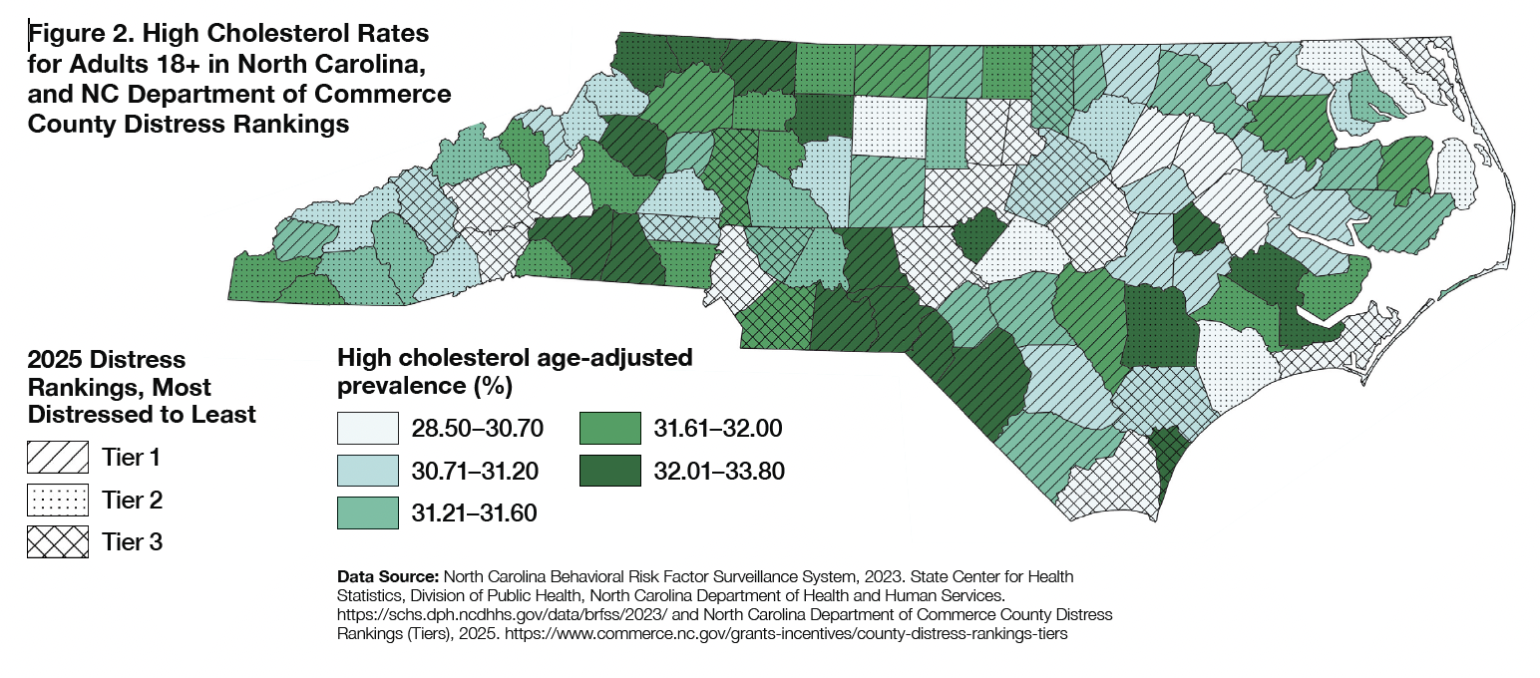
Data Source: North Carolina Behavioral Risk Factor Surveillance System, 2023. State Center for Health Statistics, Division of Public Health, North Carolina Department of Health and Human Services and North Carolina Department of Commerce County Distress Rankings (Tiers), 2025.
References
- National Center for Chronic Disease Prevention and Health Promotion Division for Heart Disease and Stroke Prevention. High Cholesterol Facts. Centers for Disease Control and Prevention. Retrieved on May 6, 2025, from https://www.cdc.gov/cholesterol/data-research/facts-stats/index.html.
- North Carolina Division of Public Health State Center for Health Statistics. 2023 Behavioral Risk Factor Surveillance System (BRFSS) Survey Results. NC Department of Health and Human Services. Retrieved on May 6, 2025, from https://schs.dph.ncdhhs.gov/data/brfss/2023/.
- North Carolina Division of Public Health State Center for Health Statistics. Vital Statistics Detailed Mortality Statistics, North Carolina Residents, 2022. NC Department of Health and Human Services. Retrieved on May 6, 2025, from https://schs.dph.ncdhhs.gov/data/brfss/2023/nc/all/toldhi3.html.
- North Carolina Division of Public Health State Center for Health Statistics. 2021 Behavioral Risk Factor Surveillance System (BRFSS) Survey Results. NC Department of Health and Human Services. Retrieved on May 6, 2025, from https://schs.dph.ncdhhs.gov/data/brfss/2021/.
- National Center for Chronic Disease Prevention and Health Promotion Division for Heart Disease and Stroke Prevention. Testing for Cholesterol. Centers for Disease Control and Prevention. Retrieved on May 6, 2025, from https://www.cdc.gov/cholesterol/testing/index.html.
- National Center for Chronic Disease Prevention and Health Promotion Division for Heart Disease and Stroke Prevention. Treat and Manage High Cholesterol. Centers for Disease Control and Prevention. Retrieved on May 6, 2025, from https://www.cdc.gov/cholesterol/treatment/index.html.
- America’s Health Rankings. Summary of North Carolina. United Health Foundation. Retrieved on May 6, 2025, from https://www.americashealthrankings.org/explore/states/NC.
- National Heart, Lung, and Blood Institute. Blood Cholesterol: Causes and Risk Factors. National Institutes of Health. Retrieved on June 19,2025, from https://www.nhlbi.nih.gov/health/blood-cholesterol/causes.
- The North Carolina Department of Commerce. (2024). County Distress Rankings (Tiers). Retrieved on May 6, 2025, from https://www.commerce.nc.gov/grants-incentives/county-distress-rankings-….
In addition to the above references this fact sheet was developed with heavy reliance on information from: The NIH National Heart, Lung, and Blood Institute website https://www.nhlbi.nih.gov/health-topics/high-blood-cholesterol and the Centers for Disease Control and Prevention website https://www.cdc.gov/cholesterol/index.html