
Blood Spot Screening
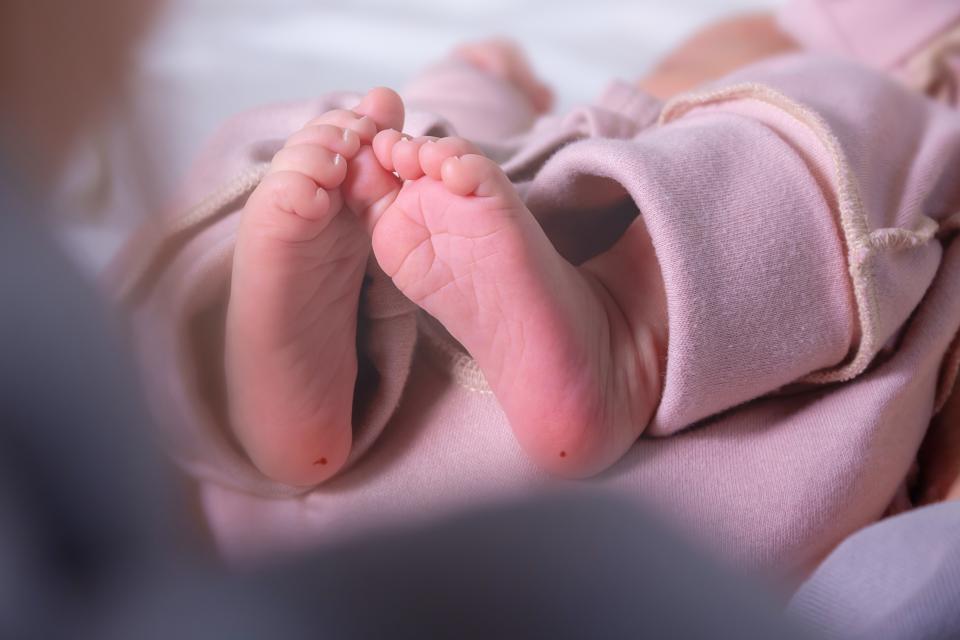
Blood spot screening uses a few drops of blood from a baby's heel to check for serious but treatable health conditions. This screening is sometimes called a "heel stick" and takes place 24-48 hours after birth.
Newborn screening dried blood spot testing is sometimes mistakenly called the 'PKU test.' This term comes from the fact that screening began with testing for PKU (phenylketonuria). The program has since expanded to include dozens of conditions and is now called newborn screening dried blood spot testing.
What to expect
To take the blood spot, a health care provider will:
- Gently warm the baby’s foot to increase blood flow
- Make a quick pinprick on the baby’s heel
- Collect a few small drops of blood on a screening card from the baby’s heel
Once the blood spots have dried, the health care provider will send the card to the North Carolina State Laboratory of Public Health (State Laboratory). The State Laboratory will run a series of tests looking for signs of certain serious conditions.
Health care providers will get results from blood spot screening in about five to seven days. Either the health care provider or the North Carolina newborn screening follow-up program will contact the parents if the baby has any results needing follow-up.
To learn more about blood spot screening results, visit the Newborn Screening Results page.
Conditions tested
In North Carolina, the blood spot screening tests for two groups of conditions:
- Conditions targeted by newborn screening (core conditions). Newborn screening focuses on finding these conditions to allow for early intervention and treatment.
- Conditions that newborn screening might also identify (secondary conditions). These conditions are not the primary target of the screening. Secondary conditions can be identified during the process of screening for core conditions.
North Carolina screens for the following core conditions:
Endocrine Disorders
Conditions that produce too much or too few hormones in the body:
- Congenital adrenal hyperplasia (CAH)
- Primary congenital hypothyroidism (CH)
Hemoglobin Disorders
Conditions that affect the shape or amount of red blood cells in the body in an unhealthy way:
- S,S disease (sickle cell anemia)
- S,C disease
- S, ßeta-thalassemia
Metabolic Disorders, Amino Acid Disorders
Conditions caused when the body has trouble breaking down amino acids, causing a build-up in the body and health problems:
- Argininosuccinic aciduria
- Citrullinemia, type I
- Classic phenylketonuria (PKU)
- Homocystinuria
- Maple syrup urine disorder (MSUD)
- Tyrosinemia, type I
Metabolic Disorders, Fatty Acid Oxidation Disorders
Conditions caused when the body has trouble breaking down fats and turning them into energy:
- Carnitine uptake defect/carnitine transport defect
- Long-chain L-3 hydroxyacyl-CoA dehydrogenase (LCHAD) deficiency
- Medium-chain acyl-CoA dehydrogenase (MCAD) deficiency
- Trifunctional protein deficiency
- Very long-chain acyl-CoA dehydrogenase (VLCAD) deficiency
Metabolic Disorders, Organic Acid Conditions
Conditions caused when the body has trouble breaking down fats and proteins and turning them into energy:
- 3-hydroxy-3-methyglutaric aciduria
- 3-methylcrotonyl-CoA carboxylase deficiency
- Glutaric acidemia type 1
- Holocarboxylase synthase deficiency
- Isovaleric acidemia
- Methylmalonic acidemia, cobalamin disorders
- Methylmalonic acidemia, methylmalonyl-CoA mutase
- Propionic acidemia
- ß-ketothiolase deficiency
Other Disorders
- Biotinidase deficiency
- Classic galactosemia
- Critical congenital heart disease (CCHD)
- Cystic fibrosis (CF)
- Glycogen storage disease type II (Pompe)
- Hearing loss
- Mucopolysaccharidosis type I (MPS I)
- Mucopolysaccharidosis type II (MPS II)
- Severe combined immunodeficiency (SCID)
- Spinal muscular atrophy due to homozygous deletion of exon 7 in SMN1 (SMA)
- X-linked adrenoleukodystrophy (X-ALD)
North Carolina identifies the following secondary conditions:
Hemoglobin Disorders
Conditions that affect the shape or amount of red blood cells in the body in an unhealthy way:
- Various other hemoglobinopathies (Hgb C/D/E Disease)
Metabolic Disorders, Amino Acid Disorders
Conditions caused when the body has trouble breaking down amino acids, causing a build-up in the body and health problems:
- Argininemia
- Benign hyperphenylalaninemia
- Biopterin defect in cofactor biosynthesis
- Biopterin defect in cofactor regeneration
- Citrullinemia, type II
- Hypermethioninemia
- Tyrosinemia, type II
- Tyrosinemia, type III
Metabolic Disorders, Fatty Acid Oxidation Disorders
Conditions caused when the body has trouble breaking down fats and turning them into energy:
- Carnitine acylcarnitine translocase deficiency
- Carnitine palmitoyltransferase I deficiency
- Carnitine palmitoyltransferase type II deficiency
- Glutaric acidemia type II
- Medium-chain ketoacyl-CoA thiolase (MKAT) deficiency
- Medium/Short Chain 3-Hydroxy Acyl-CoA Dehydrogenase Deficiency
- Short-chain acyl CoA dehydrogenase (SCAD) deficiency
Metabolic Disorders, Organic Acid Conditions
Conditions caused when the body has trouble breaking down fats and proteins and turning them into energy:
- 2-methyl-3-hydroxybutyric aciduria
- 2-methylbutyrylglycinuria
- 3-methylglutaconic aciduria
- Isobutyrylglycinuria
- Malonic acidemia
- Methylmalonic acidemia with homocystinuria
Other Disorders
- Galactoepimerase (GALE) deficiency
- Galactokinase (GALK) deficiency
- T-cell related lymphocyte deficiencies
Screening beyond the newborn period
Teen/Adult hemoglobinopathy screening
As part of newborn screening, babies receive a hemoglobinopathy screen. This looks for conditions like sickle cell disease and sickle cell trait. The State Laboratory does not perform sickle cell trait testing for school and college athletics. Health care providers can order sickle cell trait testing from commercial laboratories.
Known PKU screening
If a baby is diagnosed with PKU, North Carolina offers follow-up screening to monitor phenylalanine levels.
Critical Congenital Heart Disease (CCHD) Screening
Critical congenital heart disease (CCHD) is a group of serious heart conditions that are present at birth. These heart conditions affect blood flow and oxygen delivery to the brain, heart and other parts of the body. Some types of CCHD may cause low oxygen levels, even if the baby appears well and has no symptoms. The goal is to find these heart conditions early before babies leave the hospital.
Without early detection, these heart conditions can be life-threatening. Heart disease screening, also called pulse oximetry screening, helps find babies who need more testing or treatment.
What to expect
To check for these conditions before the baby leaves the hospital:
- The health care provider places a sensor wrap on the baby’s right hand or wrist and on one foot.
- The sensor measures the oxygen levels in the baby’s blood.
- A monitor displays the results in real time. Health care providers can help parents understand their baby’s results.
If a baby does not pass this screening, they may receive more testing to see if there is a heart condition or another problem. Tests could include an echocardiogram (heart ultrasound), electrocardiogram (EKG/ECG to check heartbeat) and/or chest X-ray.
Hearing Screening
The hearing screening checks a baby’s hearing shortly after birth. The screening uses soft sounds played through small earbuds or earphones.
Babies learn by hearing voices and sounds around them. Hearing is important for speech and language development, which begins at birth. Even mild hearing loss can delay speech, language, and communication skills unless it is found and treated early. Hearing screening helps identify hearing loss in babies as soon as possible, so they can get the support they need during this key period of brain development.
Hearing screening works best when a baby is calm and in a quiet room. Parents may hold or swaddle their baby during the test.
What to expect
A health care provider will:
- Place earbuds or earphone on the baby
- Play a soft sound
- Measure the baby’s response
Parents will get their baby’s results right after the screening.
A baby may not pass the hearing screening for several reasons:
- Hearing loss in one or both ears
- Fluid in the ear
- Movement or noise during testing
If a baby does not pass the hearing screening (a “fail”), the doctor will refer the family to a specialist for more testing as soon as possible. This second test typically happens one to two weeks later.
North Carolina Early Hearing Detection and Intervention (EHDI) Program
The North Carolina Early Hearing Detection and Intervention Program (NC EHDI) works to ensure that all newborns and toddlers with hearing loss are identified as early as possible and receive the care and treatment needed.
Contact the NC EHDI Program for more information.
- Phone: 919-707-5631 or 866-431-7434
- Fax: 919-870-4881
- Email: ncnewbornhearing@dhhs.nc.gov
- Website: North Carolina EHDI Program