
What We Do
Wastewater Monitoring in North Carolina
What is Wastewater?
Wastewater is water that flows from homes, schools, health care facilities, and businesses after people use sinks, toilets, washing machines, and showers. This water carries small traces of viruses and bacteria that can help us understand community health.
Why We Monitor Wastewater?
We test wastewater to look for germs that can cause illness. These germs, called pathogens, help show whether infections are increasing, decreasing, or newly appearing in a community. Wastewater represents everyone in the area, including people who may not visit a doctor or get tested. This gives us a more complete picture of community health.
How Are Wastewater Samples Collected?
Wastewater treatment plants collect samples twice each week. Each sample includes wastewater from a full day, which helps show what is happening across the entire community. The samples are then sent for testing to our partner laboratories, including the State Lab for Public Health and University of North Carolina.
How We Share Results?
After our labs test the samples, our team reviews the data for trends. We share results with local health departments and wastewater utilities. The public can view this information on our data dashboard, and our team is available to answer questions.
How Wastewater Monitoring Works
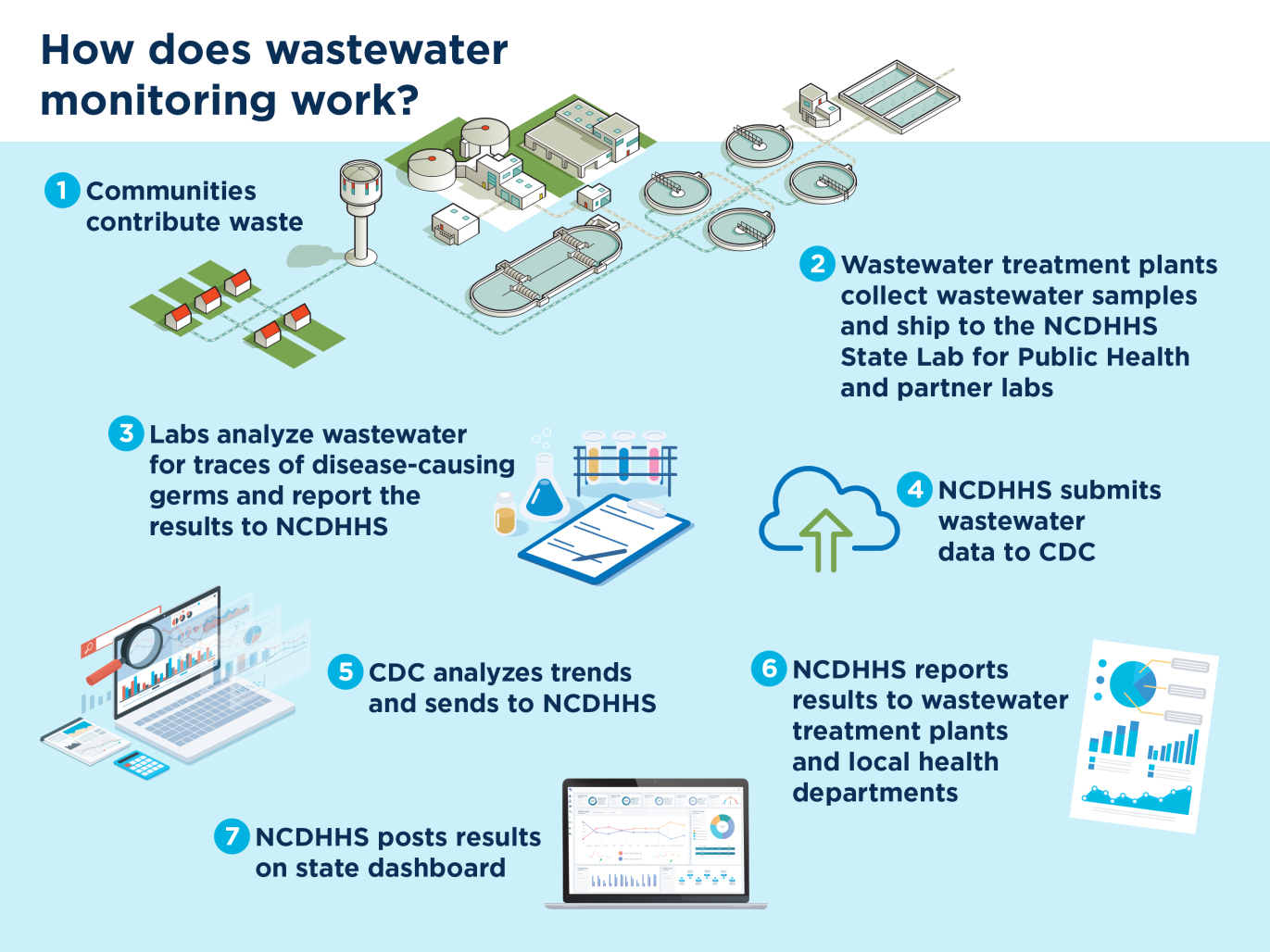
- People in a community contribute waste.
- Wastewater treatment plants collect samples and send them to the State Laboratory of Public Health and partner labs.
- Labs test the wastewater for disease causing germs.
- NCDHHS sends wastewater data to the CDC.
- The CDC studies national trends and reports back to NCDHHS.
- NCDHHS shares results with wastewater treatment plants and local health departments.
- Wastewater results are posted to the state dashboard for the public.
How Wastewater Monitoring Helps Communities
Early Signs of Illness
Wastewater can show signs of illness before people start seeking medical care. This early information helps local health departments respond quickly by sharing health messages or encouraging vaccination.
Supporting Public Health Decisions
Because wastewater reflects the health of the entire community, it supports other public health tools like hospital data or case reports. People can also use wastewater trends to guide personal decisions, such as attending large gatherings during times of higher illness activity.
Tools for Local Health Departments
We created decision trees and resources to guide responses when certain pathogens appear in wastewater. Communities can contact us to learn how to use these tools.
Real World Examples from North Carolina
Community Feedback
Dashboard users have shared that wastewater data helps them understand trends and make personal decisions. This feedback guides improvements to our tools and dashboard. We welcome feedback at any point through the form linked on our dashboard website. *Provide link - User Feedback Survey - North Carolina Department of Health and Human Services
Measles Response
Wastewater data helped detect measles activity in Mecklenburg County. This early information supported a local vaccination campaign.
Hepatitis A Study
A study described how wastewater detections of hepatitis A helped guide public health actions during multiple detections across the state. This showed how wastewater can support case investigation.
Source: Public Health Reports (2025).
Mpox Detection
Wastewater detections of mpox (Clade I) informed a press release encouraging the public and health care providers to be alert to symptoms.
Source: NCDHHS (2025)
Our Role as a Center of Excellence
Serving the Southeast
As a CDC recognized Center of Excellence, we support wastewater monitoring across the southeastern United States. We work with states, health departments, utilities and academic partners to improve wastewater monitoring systems.
Working Together
We hold monthly meetings with wastewater teams in the region. These meetings help states share knowledge, solve problems and strengthen monitoring efforts. Our goal is to ensure wastewater monitoring continues to support public health in meaningful ways.
Learn More
For communities, utilities and health departments interested in program details, lab methods or scientific studies, please see our Technical Notes.