
Using Injury Data: What You Should Know by Injury Topic
Understanding Overdose Data
What Are Provisional Data?

Provisional data are early numbers that have not been fully checked or do not have all the information they normally have before being considered final.
Provisional data allow us to:
- Access information quickly.
- Spot changes in injury trends before the final data are ready.
- See patterns that help us know when to take action.
For more information on provisional data and when they become available, visit How IVPB Uses Provisional Data.
Considerations for Using Provisional Overdose Data
Provisional data should be used carefully because there may be missing information or delays in reporting.
- Because data are always being collected and updated, provisional data can change as new information is added.
- How complete provisional data are varies by data source, data system, and when the data are accessed.
- The quality and completeness of the information can also be different for different groups of people.
Whenever provisional data are used a note should be included to indicate the data are provisional.
- This allows people to know that the data can change so they can use the data appropriately.
- For example:
- Report Title – North Carolina Emergency Department (ED) Visits for Opioid Overdose: April 2025* Update
- Report Footnote – *Data for 2024 - 2025 ED visits are provisional.
Below is a summary of some of the provisional data IVPB uses to monitor overdoses.
Provisional ED Visit Data from the North Carolina Disease Event Tracking and Epidemiologic Collection Tool (NC DETECT)
ED visit data from NC DETECT are the fastest data available for injury surveillance, with about a one-month delay.
- ED data are used to create monthly overdose reports at the state and county levels on ED visits for opioid overdose and ED visits for all drug overdoses.
- These reports are posted to the NC IVPB Overdose Epidemic Data website and are shared with partners across the state to help health officials and communities make decisions.
Provisional ED visit data are also available to authorized local or state public health users in “near real time” through the NC DETECT data portal. Since the data are updated often, running the same search at different times might give varying results as new information is added.
Provisional Death Certificate Data
It is important to consider delays and incomplete information when using provisional data to track overdose deaths in NC.
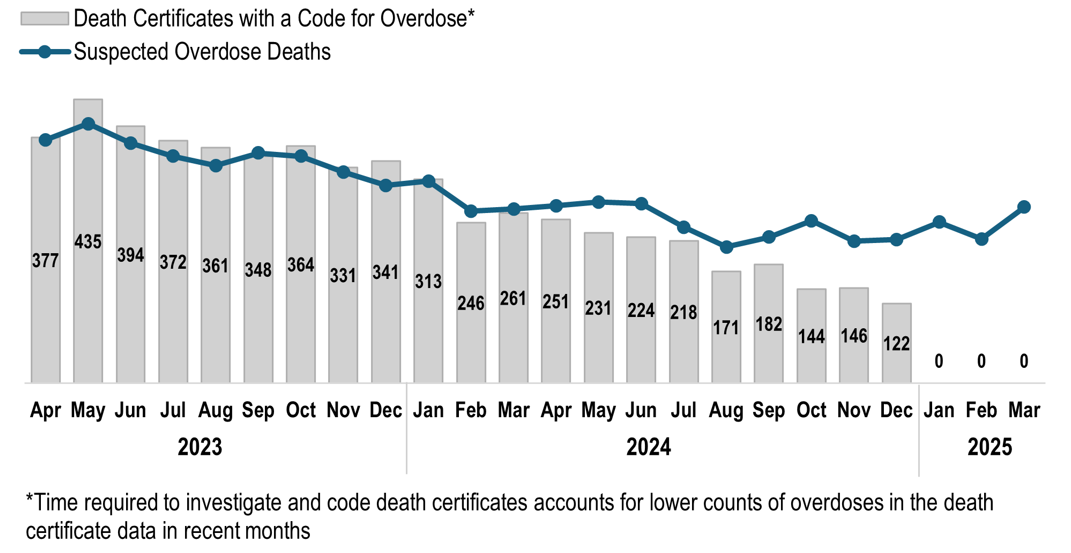
Using provisional death certificate data as soon as they are reported can show fewer overdose deaths than there really were.
This is because some records may not be fully updated with the correct overdose code.
- There is a delay in death certificate data in all states.
- Overdose deaths take longer to finalize because they need time for investigation.
- It takes time to confirm the cause of death and assign an International Classification of Diseases 10 (ICD-10) code. These are codes used to classify and describe the primary and underlying causes of death.
- Coding of death certificates currently takes longer in NC than in most other states because of system changes and delays in autopsy reporting.
- Provisional death certificates may have a pending ICD-10 cause of death code (R99) when they are first reported into the state’s system to track death records, NC DAVE (Database Application for Vital Events).
- This code is usually updated to a more specific cause of death code before the
- NC death certificate data are finalized.
- Many deaths confirmed as overdoses in the final death certificate data were first reported to NC DAVE with a R99 code.
Why is this important?
- CDC, the media, and others report estimated overdoses for states using data states submit to a national system at CDC.
- For NC, using provisional data from the national system can be a problem.
- Longer delays in death certificate coding in NC may cause provisional data to be more incomplete than they are for other states.
- Delays in coding can make it look as if there have been fewer overdose deaths in NC than there really were.
More than one provisional indicator can be used to monitor overdose deaths.
Each indicator considers the delay in death certificate coding in its own way.
Because of this, data from the Centers for Disease Control and Prevention (CDC) and other NC programs can be different from the data shared by IVPB. NC and national indicators are described further below.
IVPB has worked with the Office of the Chief Medical Examiner (OCME) to create faster indicators to track overdose deaths using OCME data.
- These indicators are used to create the IVPB Monthly Overdose Reports on suspected overdose deaths and fentanyl-positive deaths.
- For more information on differences between IVPB data and other sources, visit Differences in Reported Data.
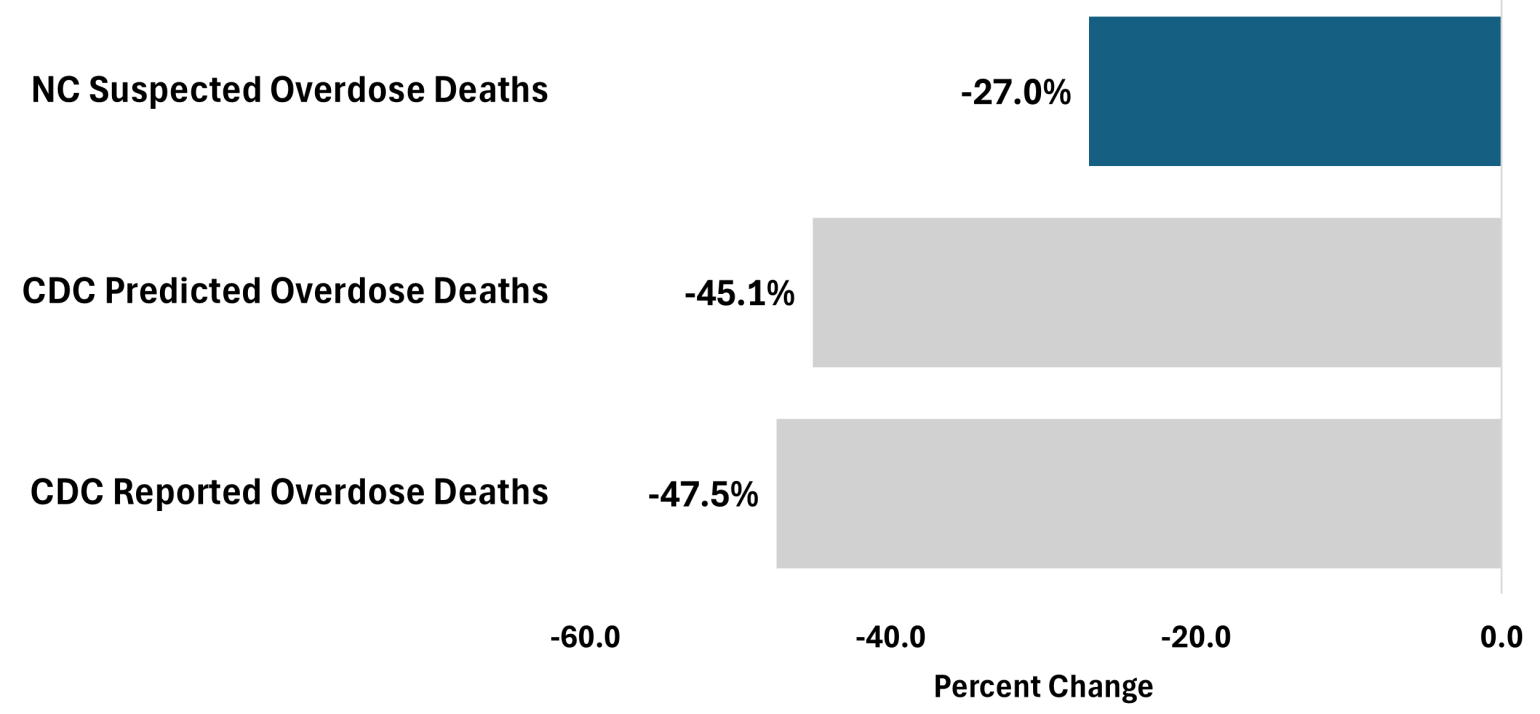
Not all overdose deaths have been assigned an ICD-10 code for overdose in the provisional death certificate data yet.
- This can make it seem like there has been a big decrease in overdoses in NC.
- The NC Suspected Overdose Deaths indicator using OCME data provides a more realistic idea of the changes in overdose deaths in the state.
- IVPB waits 6 months before using provisional death certificate data, allowing more time for overdose deaths to be assigned an ICD-10 code for overdose.
Percent Change in the Number of Overdose Deaths from October 2023 to October 2024 Across Provisional Overdose Death Indicators
Recommended Indicators to Track Provisional Overdose Deaths in NC
NC Suspected Overdose Deaths
- Estimates overdose deaths using data from OCME.
- Gives a more accurate and up-to-date count of overdose deaths.
- Only available at the state-level with a one-month delay.
- Some suspected overdoses may be reported as non-poisoning deaths in the final death certificate data, but most are confirmed as poisoning deaths.
- There was a 2% difference between the number of suspected and confirmed overdose deaths from 2019-2023.
Last 24 Months of Overdose Deaths Comparing Death Certificates Coded for Overdose to the Suspected Overdose Indicator Using OCME Data
Fentanyl-Positive Deaths
- Tracks deaths that tested positive for fentanyl but have not yet been confirmed with a final cause and intent of death using OCME toxicology data.
- Available at the state and county level with a three-month delay.
- Can be used as an early estimate when death certificate data have not been coded yet, since most overdoses in NC involve fentanyl (about 80%).
- It may be decided that fentanyl was not the main cause of death, but most are reported as overdoses.
CDC Indicators for Tracking Provisional Overdose Deaths in NC
CDC Predicted Overdose Deaths
- Created by the CDC to help estimate how many people died from overdoses across the country and in each state/jurisdiction.
- Uses provisional data that are regularly reported to the National Center for Health Statistics (NCHS) from states and jurisdictions.
- Factors in missing overdose death reports.
- Can still underestimate overdose deaths because of the delays in coding.
CDC Reported Overdose Deaths
- Measures the number of deaths that have been reported and labeled with an ICD-10 code for an overdose in the death certificate data.
- Underestimates the true number of overdose deaths because of the longer delay in coding in the death certificate data.
- May miss overdose deaths in NC that get an ICD-10 code after the National Vital Statistics data are finalized.
For more information on differences between NC and national data sources, visit Differences in Reported Data.
Coming soon