
How to Use Injury Data
Examples of How to Use IVPB Injury Data
Injury data offer valuable insights into how often injuries happen – like overdose, unintentional falls, firearm-related injuries, suicides – what causes or contributes to them, and the outcomes they lead to.
These data can be used in many ways, from identifying risks, tracking trends, and developing effective prevention strategies, to supporting advocacy, funding decisions, and public awareness campaigns.
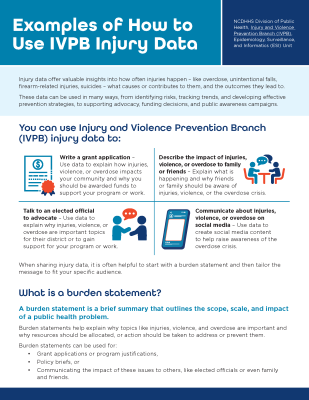
You can use Injury and Violence Prevention Branch (IVPB) injury data to:
- Write a grant application
- Use data to explain how injuries, violence, or overdose impacts your community and why you should be awarded funds to support your program or work
- Describe the impact of injuries, violence, or overdose to family or friends
- Explain what is happening and why friends or family should be aware of injuries, violence, or the overdose crisis.
- Talk to an elected official to advocate
- Use data to explain why injuries, violence, or overdose are important topics for their district or to gain support for your program or work.
- Communicate about injuries, violence, or overdose on social media
- Use data to create social media content to help raise awareness of the overdose crisis.
When sharing injury data, it is often helpful to start with a burden statement and then tailor the message to fit your specific audience.
What is a burden statement?
A burden statement is a brief summary that outlines the scope, scale, and impact of a public health problem.
Burden statements help explain why topics like injuries, violence, and overdose are important and why resources should be allocated, or action should be taken to address or prevent them.
Burden statements can be used for:
- Grant applications or program justifications,
- Policy briefs, or
- Communicating the impact of these issues to others, like elected officials or even family and friends.
What to Include in a Burden Statement
Scope
What is the problem? Explain the elements of injuries, violence, or overdose that impact your community.
Scale
How big is the problem? Explain the magnitude of the issue and how many people are affected.
Impact
How are people affected? Describe real-life effects the issue has on people.
For example, you might describe:
- Injury, overdose, or violent deaths
- Non-fatal injuries, overdoses, or violence
- Economic cost of injuries, overdose, or violence
Who is affected? Explain if some groups are affected differently than others and describe any disparities that may exist.
You can also describe what would happen if action were not taken. Explain why it is important to fund, act, or care about the problem.
Data
What evidence supports the problem you are describing? You may want to include data on:
- The number of people that are impacted in a given area.
- Trends to show how overdose, injury, or violence has changed over time.
- Data on who is impacted by overdose, injury, or violence.
- How data for a given area compares to the state or the national average.
Use rates. Rates allow data to be compared between groups or places. For more information, visit Understanding Counts and Rates.
Sample Burden Statement
This example is written for a grant application and shows key things to include in a burden statement. It could be adapted for other types of injuries or violence or for other uses.
Overdose in NC
North Carolina (NC), like the rest of the nation, is in an overdose epidemic historically driven by prescription opioids and, in more recent years, driven by heroin and illicitly manufactured fentanyl. Over the last decade, the number of overdose deaths increased by 216%, from 1,278 in 2012 to 4,041 in 2021. Additionally, in 2021, there were nearly 17,000 emergency department (ED) visits related to medication and drug overdose. Restrictions implemented to slow the spread of COVID-19 in spring 2020 altered health behaviors and health care utilization nationwide. Despite NC seeing a first-time slight decrease in overdose deaths and ED visits in 2018 and a plateau continuing into 2019, the impact of the COVID-19 pandemic resulted in significant increases in 2020, which have continued until present.
The percentage of overdose deaths involving multiple substances is also on the rise (with 65% of overdoses in NC involving multiple substances), and there are continued increases not only in opiate-involved overdose deaths, but also stimulant-involved overdose deaths. Although absolute counts suggest the highest burden of overdose death is among the non-Hispanic white population (n=2,839, 43.2 per 100,000 in 2023), overdose rates showing impact per total populations indicate greater burden on some populations, particularly American Indian/Indigenous populations (n=124, 111.3 per 100,000 in 2023). The data also show that fatal overdose rates are increasing faster in non-Hispanic Black and Hispanic populations (an increase of 200% or more from 2019 to 2013).
Scope: What is the problem?
North Carolina (NC), like the rest of the nation, is in an overdose epidemic historically driven by prescription opioids and, in more recent years, driven by heroin and illicitly manufactured fentanyl.
Scale: How big is the problem?
Over the last decade, the number of overdose deaths among North Carolinians increased by 216%,…
Impact: How are people affected?
- … from 1,278 in 2012 to 4,041 in 2021. Additionally, in 2021, there were nearly 17,000 emergency department (ED) visits related to medication and drug overdose.
- … the COVID-19 pandemic resulted in significant increases in 2020, which have continued until present.
- … and there are continued increases not only in opiate-involved overdose deaths, but also stimulant-involved overdose deaths.
Impact: Who is affected?
Although absolute counts suggest the highest burden of overdose death is among the non-Hispanic white population (n=2,839, 43.2 per 100,000 in 2023), overdose rates showing impact per total populations indicate greater burden on some populations, particularly American Indian/Indigenous populations (n=124, 111.3 per 100,000 in 2023). The data also show that fatal overdose rates are increasing faster in non-Hispanic Black and Hispanic populations (an increase of 200% or more from 2019 to 2013).
Communicating the Burden of Injuries, Violence, and Overdose to Other Audiences
Burden statements should be tailored to include data points that are most important to the person or group you are communicating with.
- Include data that answer questions your audience may have or that would appeal most to them.
When talking with elected officials about injury data it is important to:
- Share data that are specific to the area or the populations they serve.
- Include data on how injuries, violence, or overdose in their area compares to the state or national average. For example:
- In our county, the suicide rate has increased by 77% from 2014 to 2023, this is much larger than the 12% increase for the state as a whole during that time.
- In 2023, the rate of overdose deaths in our county was four times greater than for the state rate (122.2 and 29.7 per 100,000, respectively).
- Include data on how injuries, violence, or overdose in their area compares to the state or national average. For example:
- Include data on the cost of injuries.
- This could include the financial cost, as well as lives lost, or other impacts.
- For example: The combined medical costs, cost of lost productivity, and value of lives lost from firearm deaths in NC totals more than $19 billion for 2023 alone (Updated from CDC WISQARS using the 2023 total firearm deaths from the NC Violent Death Reporting System).
Other considerations when sharing data with elected officials:
- Keep your message brief and to the point.
- Limit data to a few simple data points that best explain the problem.
- Make it personal.
- Include a story or testimonial about why the topic is important to you.
- Align data with real stories to make your message more memorable and feel more impactful.
- Be solutions focused.
- Offer evidence-based solutions to the problem.
- For more information, visit IVPB’s Prevention Resources.
- Be specific about what you want them to do with the information you are sharing.
You may want to talk to your family and friends about injury data to help raise awareness, reduce stigma, or bring attention to an issue that is affecting someone you care about.
When sharing data with family and friends it may be important to:
Simplify the data.
- Some people may not have experience using data and may be unfamiliar with concepts like rates.
- Adapt the way the data are presented to make it easier to understand.
| Instead of this… | Try this |
|---|---|
| The number of firearm deaths in NC has increased by 54% between 2014 and 2023. | The number of firearm deaths has gone up by more than half over the last 10 years. |
| There were 1,757 motor vehicle traffic deaths in NC in 2023. | An average of five North Carolinians died each day from motor vehicle crashes in 2023. |
| Although absolute counts suggest the highest burden of overdose death is among the non-Hispanic white population (n=2,839, 43.2 per 100,000 in 2023), overdose rates showing impact per total populations indicate a greater burden on some populations, particularly American Indian/Indigenous populations (n=124, 111.3 per 100,000 in 2023). | Although most deaths were among non-Hispanic white people living in NC, there is a larger impact on American Indian/Indigenous people when considering population size. The rate of overdose was more than 2.7 times greater for American Indians than the state as a whole. |
Humanize the data.
- While it is important to share statistics about injury, violence, or overdose, it is also important to incorporate real stories and perspectives from lived experience.
- Ensure you have consent from individuals or communities to share their stories.
- Be mindful of any harm that sharing their stories may bring to them or their community.
- Talk more about the impacts of stigma and things to consider about people with lived experience.
- Lead your conversation with empathy and curiosity.
- Know people may be coming to the conversation from different places and have their own opinions about the topic.
- Share context around how these events can happen and be considerate of how you talk about the issue to prevent victim blaming and reinforcing negative stereotypes.
- Generations of social, economic, and environmental inequities contribute to disparities in injuries, including from overdose and firearms.
- When interpreting data, it is crucial to recognize and acknowledge these systemic, avoidable, and unjust factors rather than blaming groups that may be impacted by violence or overdose more than others.
Overdose Example:
Share how overdose compares to other injuries and health outcomes to help normalize conversations about overdose.
For example, “In 2023, 12 North Carolinians died each day from overdose. That is more deaths than for other leading causes like diabetes mellitus, COVID-19, motor vehicle traffic injuries, or liver disease.”
Share that substance use disorder is a medical diagnosis and stigma can actually prevent people from receiving support and treatment.
Share information about injury, violence, or overdose prevention.
- Discuss strategies that help prevent injuries, violence, or overdose.
- Offer evidence-based solutions.
- For example, for overdose you could share resources that are available for people struggling with substance use, like where to access naloxone or Narcan, overdose reversal training, safe use practices for prevention of disease transmission, drug checking or treatment resources.
- For more information, visit IVPB’s Prevention Resources.
Sharing data on social media is a great way to:
- Raise awareness around the leading causes of injury, increases in violence, or the overdose crisis.
- Highlight disparities impacting people who use drugs and those impacted by injuries or violence.
- Encourage action to prevent injuries, violence, and overdoses.
When sharing data on social media it is important to:
- Be direct.
- Use the most important key points that are specific to what you are trying to share.
- Know why you are sharing the data, for example to inform, educate, advocate, or provide support. This can help you narrow your search to data that will be most impactful.
- Provide context to the data.
- Don’t share data without explaining what they mean.
- Not everyone is familiar with or comfortable using data and may misinterpret the data without some direction.
- Reference where the data you are sharing come from.
- Be culturally sensitive and use non-stigmatizing language.
- Be thoughtful of how data about specific groups may be received and if the way they are presented could reinforce negative stereotypes and biases.
- Be aware of privacy and avoid sharing small numbers that could identify people.
- For more information, visit Data Suppression and Working with Small Numbers.
- For terms to avoid and suggested language when talking about overdose, visit Stop the Stigma or Unshame NC.
- Include a simple chart.
- Use data visualizations that are easy to understand and clear to help explain and support the data you are including in your post.
Additional Resources
- Access the IVPB Data Resource Inventory to help find injury data resources.
- For information on the data resources available for each type of injury, visit the NC Injury Data User Toolkit.
- For information on evidence-based injury prevention strategies, visit IVPB’s Prevention Resources.