
Understanding Firearm Injury Data
Summary of Firearm Data
The Injury and Violence Prevention Branch (IVPB) creates multiple resources to help keep our partners informed about firearm injuries and deaths in NC.
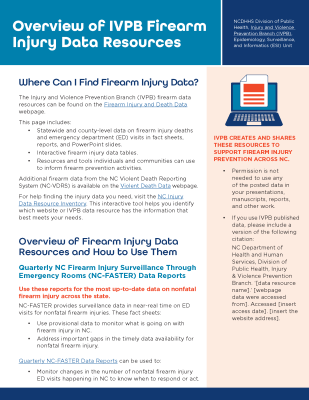
All IVPB firearm injury data resources can be found on the Firearm Injury and Death Data webpage.
This page includes:
- Statewide and county-level data on firearm injury deaths and emergency department (ED) visits in fact sheets, reports and PowerPoint slides.
- Interactive firearm injury data tables.
- Resources and tools individuals and communities can use to inform firearm prevention activities.
More firearm data from the NC Violent Death Reporting System (NC-VDRS) is available on the Violent Death Data webpage.
For help finding the injury data you need, visit the NCDHHS Injury and Violence Prevention Data Resource Inventory. This interactive tool helps you identify which website or IVPB data resource has the information that best meets your needs.
IVPB creates and shares these resources to support firearm injury prevention across NC.

- Permission is not needed to use any of the posted data in your presentations, manuscripts, reports and other work.
If you use IVPB published data, please include a version of the following citation:
NC Department of Health and Human Services, Division of Public Health, Injury & Violence Prevention Branch. ‘[data resource name].“ [webpage data were accessed from]. Accessed [insert access date]. [insert the website address].
Below is a brief summary of each resource.
Firearm Injury Data Resources
Use these reports for the most up-to-date data on nonfatal firearm injury across the state.
NC-FASTER provides surveillance data in near-real time on ED visits for nonfatal firearm injuries. These fact sheets:
- Use provisional data to monitor what is going on with firearm injury in NC.
- Address important gaps in the timely data availability for nonfatal firearm injury.
Quarterly NC-FASTER Data Reports can be used to:
- Monitor changes in the number of nonfatal firearm injury kED visits happening in NC to know when to respond or act.
- Know where firearm injuries are happening in the state and which groups are experiencing firearm injuries.
- Focus prevention and response activities to groups that are most impacted by firearm injury.
For more information on using provisional data to monitor firearm injuries in NC, visit Using Provisional Data for Monitoring Injuries.
Use these prepared PowerPoint slides to include firearm injury data in your next presentation, or as a resource to understand more about firearm injury in NC.
Firearm injury slide sets can be used to incorporate firearm data into your own presentations, grant proposals, reports, or any other way they may be useful.
- Each slide includes detailed notes explaining the information on the slide.
- Technical notes are also available to help with understanding and presenting data.
Slides are updated each year with the most recent annual data.
Firearm Injury Slide Set
The Firearm Injury Slide Set gives a detailed overview on firearm injuries and deaths in NC.
- Use these slides to understand more about firearm injuries in NC.
- The slides were created to provide basic data trends and around firearm injury in the state.
- Slides include data on:
- Who is impacted by firearm injuries in NC
- Where firearm injury occurs
- Circumstances surrounding firearm injury deaths
- Differences in firearm injuries and deaths by intent (self-inflicted/suicide, assault/homicide, unintentional injury)
- Health behaviors related to firearms (safe storage and firearm access)
Child Firearm Injury Slide Set
The Child Firearm Injury Slide Set gives a detailed overview on firearm injuries and deaths among children ages 0-17 in NC and resources to prevent child firearm injury.
- Use these slides to understand more about the burden of firearm injuries, specifically among children ages 0-17 in NC.
- The slides were created to provide basic data trends and public health surveillance around child firearm injury in the state.
- Slides include data on:
- Firearm involvement in violent injuries and deaths
- Differences in of firearm injuries and deaths by intent (self-inflicted/suicide, assault/homicide, unintentional injury)
- Demographic differences (sex, age, race/ethnicity) in child firearm injury
- Circumstances surrounding firearm injury deaths
- Relationship between the suspect and the victim
- Information on safe firearm storage
Use this fact sheet for an overview of the burden of firearm injury and death in NC.
The Firearm Injury and Death Fact Sheet includes the most recent available data on firearm deaths and firearm injury ED visits by demographic group as well as data on firearm ownership and storage practices in NC.
Use this report to:
- Monitor changes in firearm injury and death over time.
- Compare rates of firearm death in NC to the U.S. over the most recent 10 years.
- Compare trends in firearm death by manner of death (suicide, homicide, other firearm death) over the most recent 10 years.
- Compare trends in child firearm death to motor vehicle traffic deaths, a leading cause of injury death among children over the most recent 10 years.
- Compare firearm injury ED visits by month over the most recent three years.
- Understand differences in firearm injury and death by demographic group.
- Include data by sex, race/ethnicity, and age group.
- Compare differences in the manner of firearm death by race/ethnicity.
- Understand firearm ownership in NC, how North Carolinians report that they store those firearms, and how safe storage can help prevent firearm injury and death.
Use this tool to access county-level information on firearm injury and death if you are comfortable using data dashboards to query and filter data.
This interactive firearm data table includes finalized data over the most recent six-year period on firearm injury ED visits, hospitalizations, and deaths by county of residence.
- Data are presented for each county by year.
- Detailed instructions on how to filter and query the data are included above the table.
- Users can customize which counties are displayed in the table.
- Filter to a single county or select multiple counties to compare data across counties.
- Data can be filtered by data source, data type, and intent.
- ED visits can be toggled between those with ICD-10-CM codes for firearm injury or NC FASTER ED syndromic data that use keywords and ICD-10-CM codes.
- The intent filter allows users to query data for firearm injuries due to legal intervention, undetermined intent, and unknown intent (for ED syndromic data only) in addition to self-Inflicted, assault, and unintentional firearm injuries.
Use these reports to understand differences in firearm injuries and deaths across groups, statewide and at the county-level.
The Firearm Injury ORION Reports include counts and rates of firearm injury ED visits, hospitalizations, and deaths by sex, race/ethnicity, and age group over the most recent five-year period.
- Statewide reports are available by injury intent, and include:
- Firearm Injuries, All Intents
- Firearm Injuries, Assault
- Firearm Injuries, Self-Inflicted
- Firearm Injuries, Unintentional
- County-level reports are available for each NC county for firearm injuries of all intents.
- For more information on injury intent, visit Understanding Injury Mechanism and Intent.
NC-VDRS contains detailed data on firearm deaths, including circumstances surrounding deaths and the types of firearms involved.
NC-VDRS includes data on violent deaths involving firearms as well as on unintentional firearm deaths. These data are included in several NC-VDRS resources, including dashboards, analyzable datasets, factsheets and reports. Each of these is outlined further below.
For more information on NC-VDRS, visit Data Sources IVPB Uses for Injury Surveillance, or the NC-VDRS webpage.
NC-VDRS Dashboard
Use the interactive NC-VDRS Dashboard to access and data on firearm and other violent deaths if you are comfortable using data dashboards to query and filter data.
- There is a tab of the dashboard dedicated to firearm deaths that can be used to:
- Filter data by place, statewide or by county.
- Monitor changes in the number and rate of firearm deaths
- Compare the rates from 2004 through the most recent final year of data.
- There are options for single-year, five-year, and 10-year rates to ensure data are available and can be shared for each county.
- For more information, visit Data Suppression and Working with Small Numbers.
- Identify which groups are most impacted by firearm injury.
- Compare rates by sex, race/ethnicity, and age group
- Compare metrics across counties.
- Compare firearm deaths by manner.
- Currently, firearm circumstance data are not included in the dashboard, but will be added in the future.
- Firearm data are also included on the NC-VDRS Metrics, Homicide Trends, and Suicide Trends tab of the NC-VDRS Dashboard.
NC-VDRS Downloadable Aggregate Data File
Use this aggregate data file to conduct your own analyses and create your own data visualizations using NC-VDRS firearm data and data on other violent deaths.
- All of the data used to populate the NC-VDRS Dashboard are included in a downloadable NC-VDRS CSV file.
- Data are available overall and by sex, age group, and race/ethnicity at the state and county level.
- The first sheet of the file is a data dictionary that describes each of the variables included in the downloadable data.
- The second sheet includes all the primary indicators included in the dashboard.
- Each row represents the data for a given metric for each year, group (sex, age, race/ethnicity), and place (county/statewide).
- Data include the number of events for each metric, the rate (percentage or rate per 100,000 NC population), and the denominator used to calculate the rate.
- A third sheet includes data on the circumstances of violent deaths.
- Currently, firearm circumstance data are not included but will be added in the future.
- There is an accompanying data dictionary available that describes each of the variables included in the downloadable data.
NC-VDRS Firearm Violent Death Fact Sheet
Use the NC-VDRS Firearm Violent Death Fact Sheet to access data on firearm deaths by manner and demographic group and monitor trends over time.
- Monitor changes in firearm deaths by manner over time and differences in firearm injury by manner of death.
- Describes firearm involvement across the manners of violent death using the most recent final year of NC-VDRS data.
- Includes rates of firearm injury overall and by suicide, homicide, and other manner over the most recent 10 years.
- Understand the most common locations of firearm injury (e.g., apartment or home, street/roadway).
- Identify which groups are most impacted by firearm injury.
- Highlights differences in firearm death rates between male and female residents by race/ethnicity and age group.
- Visualizes differences in manner of firearm death by race/ethnicity.
NC-VDRS Annual Report
Use the NC-VDRS Annual Report for more detailed information on firearm deaths in NC.
- The annual report includes comprehensive data on all firearm deaths, firearm suicide, firearm homicide, and unintentional firearm deaths using the most recent final year of NC-VDRS data.
- Use the report to understand the circumstances surrounding firearm deaths and the types of firearms involved.
- Compare differences between circumstances surrounding firearm suicides and circumstances of non-firearm suicides.
- Compare differences between circumstances surrounding firearm homicides and circumstances of non-firearm homicides.
- Understand circumstances surrounding unintentional firearm deaths.
- Use the report to understand differences between groups and across counties.
- Data are available by sex, race/ethnicity, age group, sex and age group and by county for all firearm deaths, firearm suicide, firearm homicide, and unintentional firearm deaths.
Data on unintentional firearm deaths are also included in the county-level NC-VDRS fact sheets.
- These fact sheets use occurrence rates, and include firearm injuries that happened in a given area, regardless of whether the individuals were residents of that area.
- Most other data resources use resident rates.
- For more information visit, What Should I Know Before Using Firearm Injury Data.
Special Emphasis Report on Firearm Injuries
Use this special emphasis report to understand the impact and magnitude of firearm injury as well as firearm injury prevention strategies and activities happening in NC.
This report can be used to:
- Compare the severity of firearm injury by injury intent.
- Visualizes firearm deaths, hospitalizations, and ED visits by intent category.
- Understand differences in firearm homicide and suicide by sex, and how trends of firearm injury deaths have changed for males and females over time.
- Understand types of firearms involved in firearm deaths and differences in firearm death by race/ethnicity.
- Learn about activities happening in NC related to firearm violence prevention and surveillance, as well as ongoing partnerships and recent accomplishments.
NC Medical Journal (NCMJ) Special Issue on Firearm Injury and Violence Prevention
Use the NC Medical Journal Special Issue to understand potential prevention strategies and other considerations for preventing firearm injury and violence.
- In 2023, NCMJ published a special issue (Vol. 84, Issue 4) dedicated to firearm injury and violence.
- The issue describes the potential for changes to lower the chance of firearm-related injuries and deaths.
- Featured articles include:
- Current efforts across the state,
- Evidence-based prevention strategies, and
- Proposed solutions for at-risk groups such as veterans, adolescents, and young adults.
NC-FASTER Annual Reports
The goal of the NC-FASTER Annual Data Reports was to provide background information to partners and collaborators on the data available to support firearm injury prevention. Annual reports were created in 2022 and 2023.
These reports include:
- More detailed information on nonfatal firearm injury ED visits overall and by demographic groups.
- An overview of fatal and nonfatal firearm injuries across data sources.
- An overview of firearm injury intent coding in the ED visit data.
Currently, there are no regularly scheduled updates to this report.
Firearm Injury in North Carolina: Pervasive but Preventable
This Firearm Injury in North Carolina StoryMap serves as a placed-based data visualization to share actional local data on firearm injury Emergency Medical Services (EMS) responses.
Use this tool to:
- Understand where EMS teams respond to firearm injuries at the county and neighborhood (census-tract) level.
- Compare rates of firearm injuries for counties and neighborhoods to that area’s social vulnerability, or how likely a community is to have a hard time recovering from problems like natural disasters, violence, or health emergencies.
- Review NC firearm policies.
- Review firearm injury prevention strategies and interventions.
Currently, there are no regularly scheduled data updates to this StoryMap.
Differences in Firearm Injury by Injury Intent
Firearm Injury
Firearm injury is a mechanism, or type, of injury that IVPB monitors.
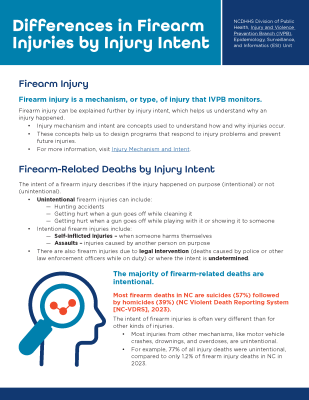
Firearm injury can be explained further by injury intent, which helps us understand why an injury happened.
- Injury mechanism and intent are concepts used to understand how and why injuries occur.
- These concepts help us to design programs that respond to injury problems and prevent future injuries.
- For more information, visit Injury Mechanism and Intent.
Firearm-Related Deaths by Injury Intent
The intent of a firearm injury describes if the injury happened on purpose (intentional) or not (unintentional).
- Unintentional firearm injuries can include:
- Hunting accidents
- Getting hurt when a gun goes off while cleaning it
- Getting hurt when a gun goes off while playing with it or showing it to someone
- Intentional firearm injuries include:
- Self-inflicted injuries – when someone harms themselves
- Assaults – injuries caused by another person on purpose
- There are also firearm injuries due to legal intervention (deaths caused by police or other law enforcement officers while on duty) or where the intent is undetermined.
Because most firearm injuries are intentional and tend to cause more serious harm than other injuries, they are more likely to result in serious outcomes, including death.
While only 1% of all injuries result in death, the percentage of firearm injuries resulting in death is much higher, at around 24% (estimated using 2023 death certificate, hospital discharge, and ED visit data).
Firearm Injuries Compared to All Injuries by Injury Severity, NC, 2023
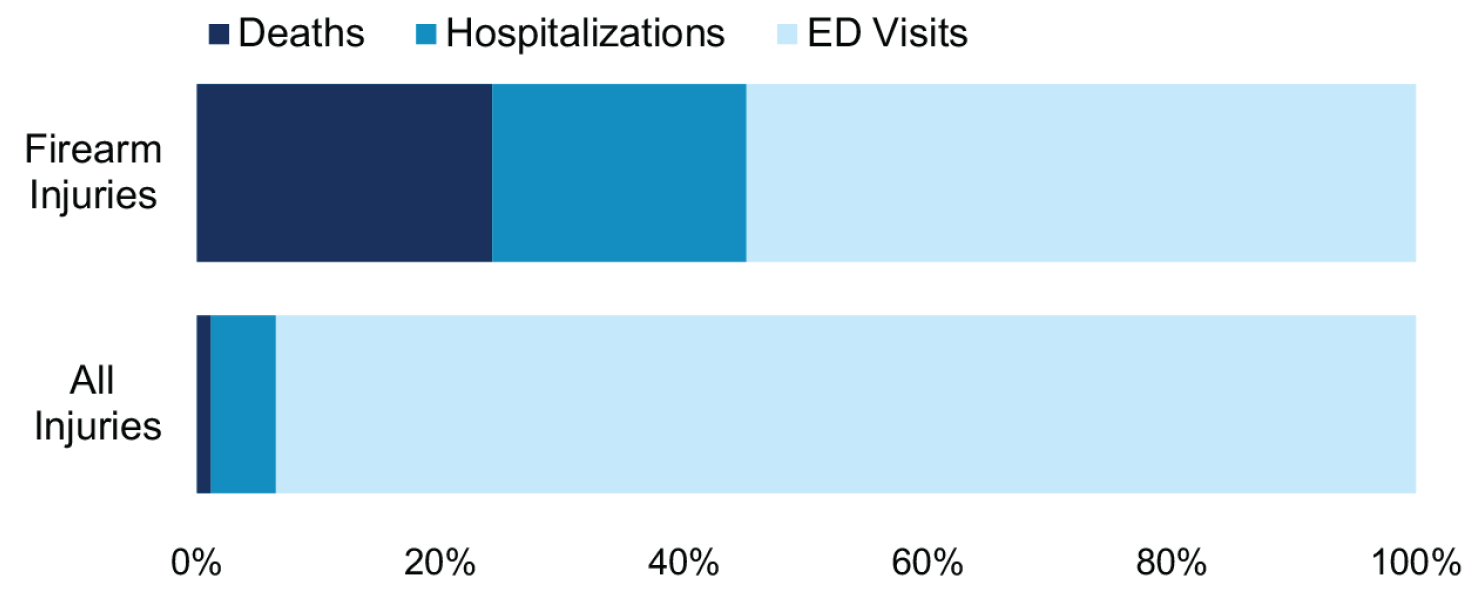
Note: Limited to NC Residents. Categories are not mutually exclusive. A person seen for a firearm injury emergency department (ED) visit may have gone on to die from the same or another firearm injury in the same year. Firearm injuries are included in the All Injuries category.
Intentional firearm injuries are more likely to result in a death than unintentional firearm injuries.
Most unintentional firearm injuries result in an ED visit or hospitalization.
- It is expected that there would be more ED visits for unintentional firearm injury than deaths, since intentional firearm injuries are usually very serious.
- However, some of the differences between fatal and non-fatal firearm injury intent is because of how these injuries are coded to group visits by diseases and conditions (ICD-10 codes for deaths and ICD-10-CM codes for non-fatal data).
- The intent of some non-fatal firearm injuries may have been coded incorrectly because of previous ICD coding rules.
- For more information, see the Injury Intent for Non-Fatal Firearm Injuries section below.
- For more information in differences in firearm injuries by intent, see the 2023 NC-FASTER Annual Report.
Firearm Injuries in NC by Data Source and Intent, 2023
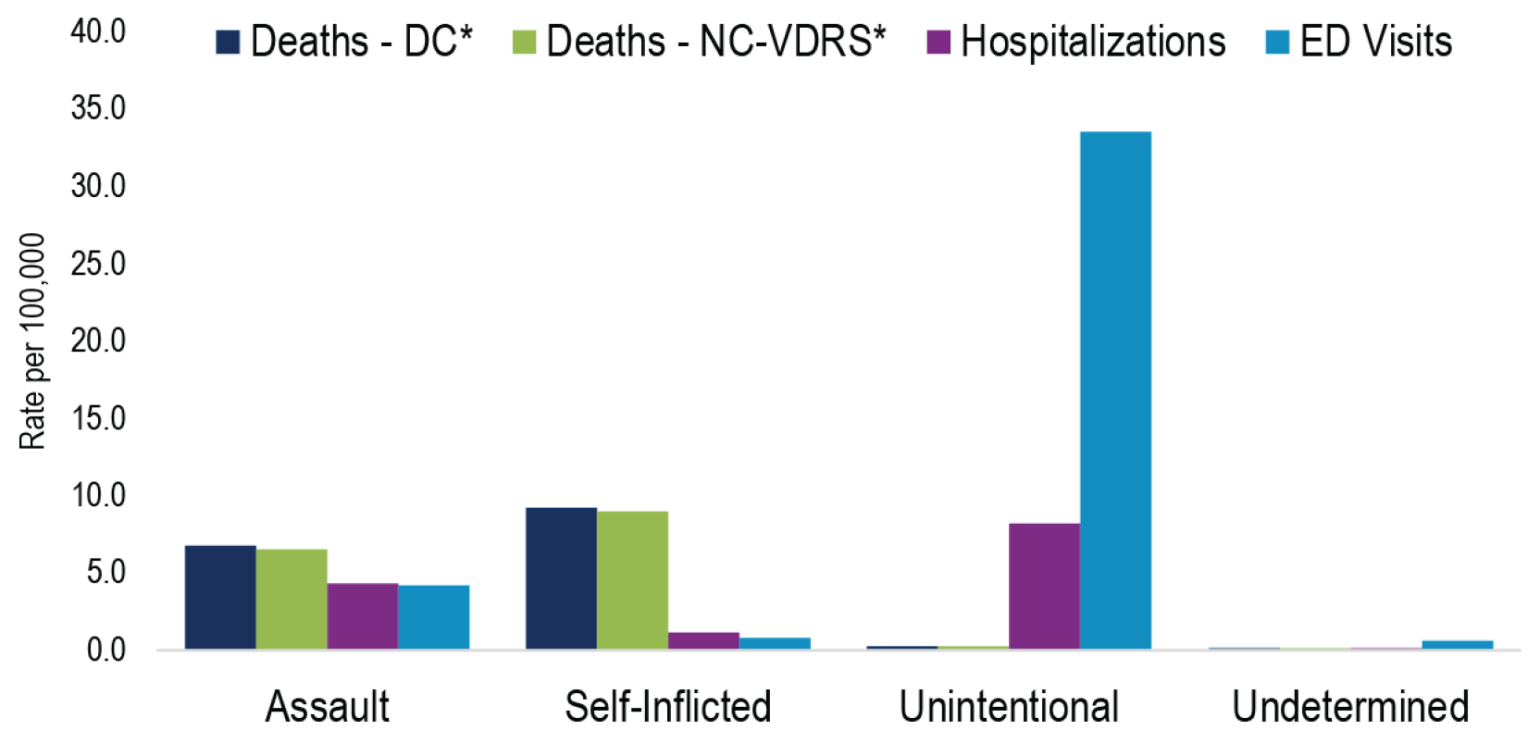
Note: Limited to NC Residents; Firearm injury rates for different data sources may overlap. The same person could appear in more than one data source for firearm injury. Coding for hospitalizations and ED visits by unintentional and undetermined intent changed on Oct. 1, 2025. Data on unintentional firearm injuries and firearm injuries of undetermined intent from before and after Oct. 1, 2025, should not be directly compared.
Injury Intent for Non-Fatal Firearm Injuries
IVPB firearm data resources include the following intents for non-fatal firearm-related injuries:
- Unintentional – when someone is accidentally injured
- Self-inflicted – when someone harms themselves
- Assaults – injuries caused by another person on purpose
- Undetermined/Unknown Intent – injuries where the is not known or is not specified. This category includes both:
- Firearm injuries of undetermined intent – includes records that have an ICD-10-CM code for undetermined intent.
- Firearms injuries of unknown intent – includes records that do not have an ICD-10-CM code with intent information.
Changes to Coding Non-Fatal Firearm Injuries (2025)
Some differences in the intent of non-fatal firearm injury and firearm-related deaths are because of how non-fatal firearm injuries are coded.
The national guidance for coding non-fatal firearm injuries was updated on Oct. 1, 2025.
Before Oct. 1, 2025, the intent for all injuries, including firearm-related injuries, defaulted to unintentional injury.
- For example, if the intent was not documented in the medical record, a firearm-related injury ED visit was coded as an unintentional firearm injury.
Defaulting to unintentional injury did not accurately describe firearm injuries, which are more likely to be intentional compared to other causes of injury.
- Most firearm-related injury ED visits were coded as unintentional injuries, followed by firearm injuries with unknown intent.
- Many ED visits for firearm injuries do not have a documented intent.
- ED providers may be hesitant to document a specific intent for a firearm injury, even when there’s strong evidence that the injury was intentional.
- Without documented intent, these visits were coded as unintentional injuries.
- Too many firearm injuries were marked as unintentional, and not enough were marked as intentional, including assaults and self-inflicted firearm injury.
As of Oct. 1, 2025, the intent of firearm injuries defaults to undetermined.
- For example, if the intent was not documented in the medical record, a firearm-related injury ED visit will now be coded as a firearm injury of undetermined intent.
- This change aligns with what information is documented in the patient record.
- Automatically coding these records as assault or self-inflicted could have caused those types of firearm ED visits to seem higher than they really are.
The change in firearm coding guidance causes more firearm injuries to be coded as undetermined intent and fewer to be coded as unintentional firearm injuries.
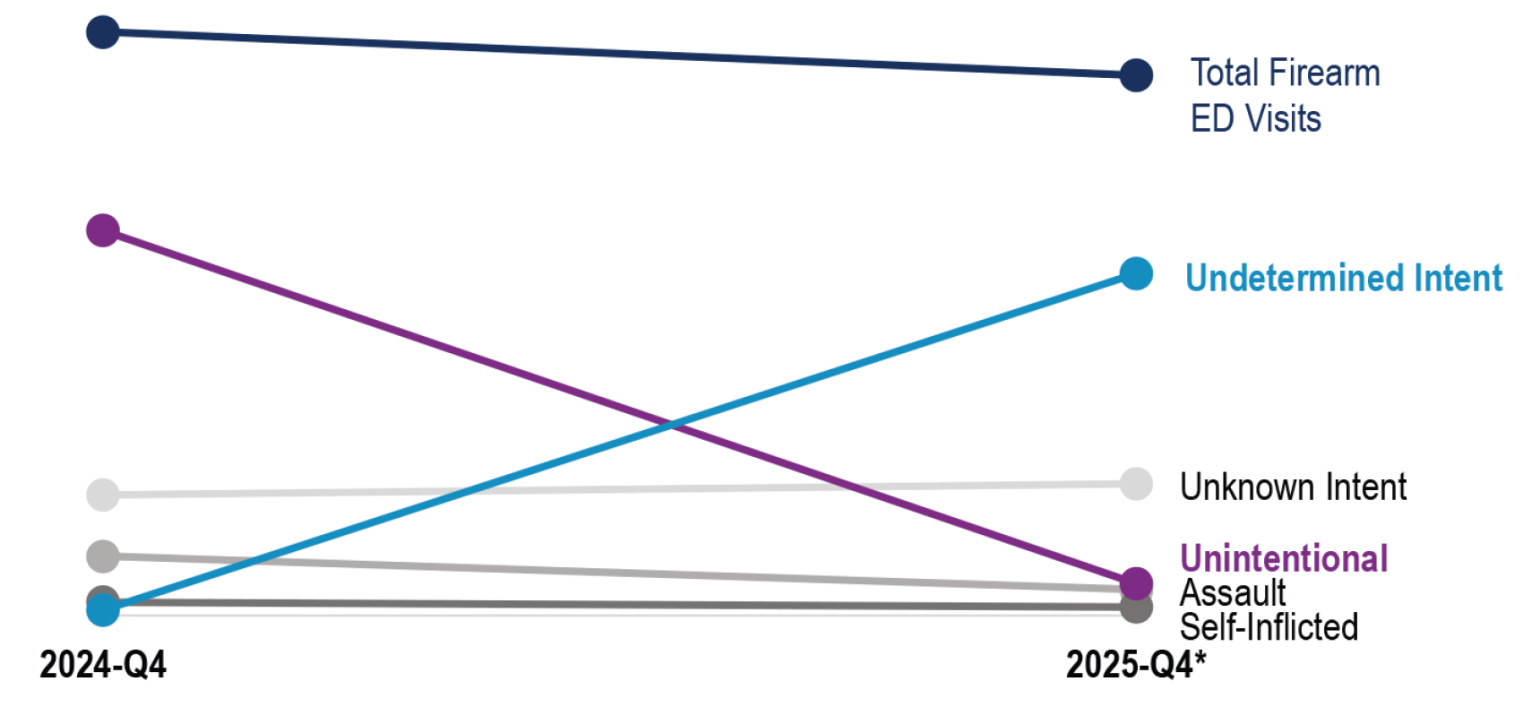
Note: Data are provisional and subject to change, data as of 1/25/2026
NC DETECT, ED Visit Data, NC-FASTER Firearm Injury - All Intents Centers for Disease Control and Prevention (CDC) V2 Syndrome, Oct-Dec 2024 and Oct-Dec 2025
- Before the Oct. 1, 2025, change, counts of undetermined firearm injuries were very low.
- Data on unintentional firearm-related injuries and firearm-related injuries of undetermined intent from before and after the change on Oct. 1, 2025, should not be directly compared.
- We cannot control these changes and are unable to apply them to historical data the way we can for changes to injury surveillance case definitions.
- For more information on case definitions, visit Understanding Injury Surveillance Case Definitions.
- Syndrome case definitions, like those used by NC-FASTER and the CDC, use keywords as well as ICD-10-CM codes to identify ED visits related to firearm injury.
- Syndromes identify more ED visits related to firearm injury than when using ICD-10-CM codes alone.
- Visits identified using only keywords often do not have information about the intent of the injury.
- For more information on syndromes, visit Understanding Injury Surveillance Case Definitions.
- CDC currently includes firearm injuries of undetermined intent in the unintentional firearm injury syndrome definition.
- CDC definitions have not been updated based on the changes to the ICD coding guidance on Oct. 1, 2025.
- Firearm injury ED visits identified using CDC syndromes will still show more unintentional injuries than other injury intents because the unintentional injury syndrome includes firearm injuries of undetermined intent.
- Firearm injuries identified using keywords are grouped by injury intent based on the ICD-10-CM codes assigned to the record.
- The labeling of intent categories in NC-FASTER reports was updated to more accurately describe the data.
- Before the coding change, records with keywords for firearm injury but no ICD-10- CM code for injury intent were labeled as “Undetermined” intent.
- “Undetermined” intent will now describe firearm injuries that were specifically coded as firearm injuries of undetermined intent.
- NC-FASTER data may not match data shared by CDC based on the differences in firearm syndrome definitions.
Some ED visits may have more than one medical code for firearm injuries for different intents.
- This can happen when the ED visit record includes details about the injury event, not just what happened to the person being treated for firearm injury.
- For example, if someone shoots another person and accidentally shoots themselves during the same incident.
- IVPB handles these records differently for ICD-10-CM code-based firearm injury case definitions and for NC-FASTER definitions that also consider keywords.
- For ED visits identified with only ICD-10-CM codes, the visit is counted once in each intent category that applies (such as for total firearm assaults or total unintentional firearm injuries), but only once in the total number of firearm injury ED visits.
- For ED visits identified using NC-FASTER definitions, intent defaults to an intentional category (e.g., self-inflicted, assault) if an ED visit includes information for intentional firearm injury and another intent category.
For more information, visit What Should I Know Before Using Firearm Injury Data.
Populations in NC experience firearm injuries differently.
Differences in Firearm Injury Intent by Age
Firearm homicide and firearm suicide follow different patterns with respect to age.
- Firearm suicides are more common among older adults, while firearm homicides happen more often among younger ages.
- Firearm suicides are limited to those ages 10 and older.
Firearm Death Rates (per 100,000) by Manner and Age Group, NC-VDRS, 2014-2023
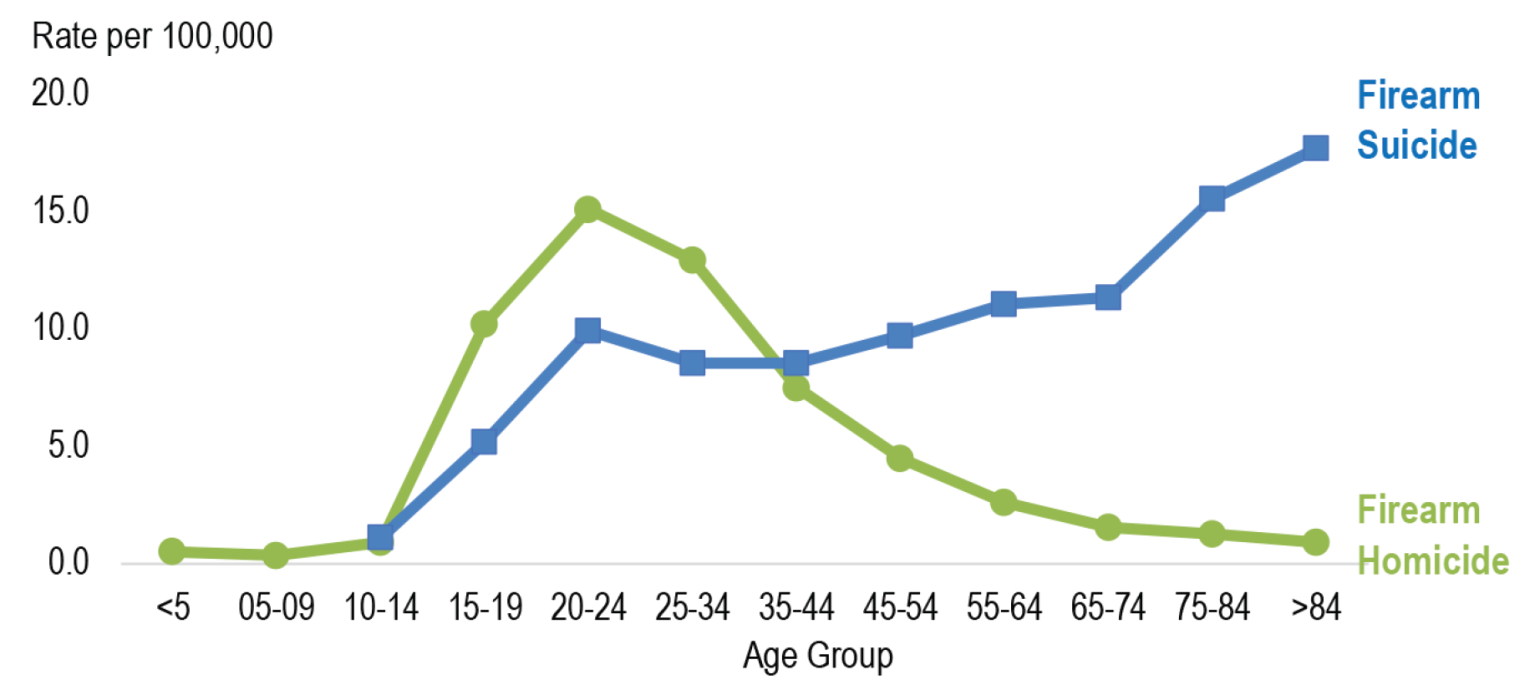
Source: NC-VDRS, 2014-2023; U.S. Census non-bridged population estimates, 2014-2023
Differences in Firearm Injury Intent by Sex
- Males tend to have higher rates of firearm injuries across all injury intents.
- More female firearm-related deaths are homicides than males.
- More male firearm-related deaths are suicides than females.
Differences in Firearm Injury Intent by Race and Ethnicity
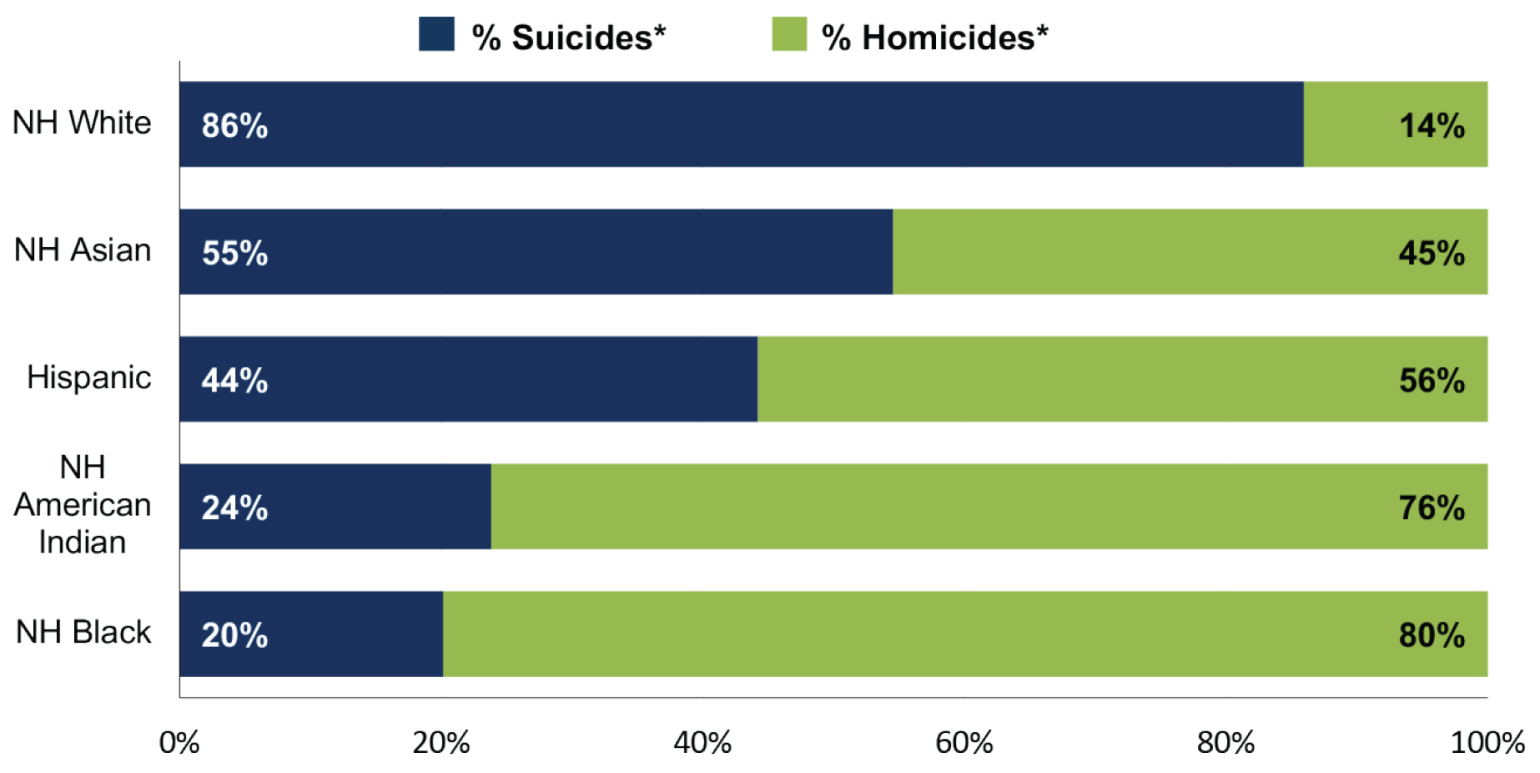
There are large differences in the intent of firearm injuries between racial/ethnic groups.
- Among non-Hispanic white residents, most firearm-related deaths are suicides.
- Among historically marginalized communities, firearm-related deaths are more often caused by interpersonal violence (homicide).
- There are similar racial and ethnic differences for non-fatal firearm injury.
What Should I Know Before Using Firearm Injury Data?
IVPB firearm injury data can be used in many ways, from:
- Identifying risks
- Tracking trends
- Developing effective prevention strategies
- Supporting advocacy, funding decisions and public awareness campaigns
This document outlines what you should know and consider before using firearm injury data included in IVPB firearm injury data resources.
Data Considerations
Who is included in Firearm Injury Data?
Occurrence vs Residence When Measuring Firearm Injury
Occurrence describes where something happened. Residence describes the area where someone has reported that they live.
Residence Rates
Most firearm injury data are limited to firearm injuries among NC residents.
County-level data are limited to county residents, except for the NC Violent Death Reporting System (NC-VDRS) county-level factsheets, which use occurrence rates (see below for more information).
- Limiting to residents allows for rate calculations using NC resident population estimates.
- This excludes people that experience a firearm injury in a county but are not residents of that county.
- While limiting to county residents works well for most counties, there are some counties where this has a large impact on the local firearm injury rate.
Occurrence Rates
The county-level NC-VDRS fact sheets include data on unintentional firearm deaths, as well as how often firearms are used in homicides and suicides. These fact sheets use occurrence rates and include firearm injuries that happened in a county, regardless of whether the individuals were residents of that county.
- For counties with lots of people coming and going, the occurrence rate is often higher than the resident rate. This is especially true for:
- Counties with college towns
- Counties that have popular tourist destinations, or mountain/beach towns
- Counties or areas with large populations of people experiencing homelessness
- Limiting to residents would exclude these transient populations and can underestimate the burden of firearm injury on local systems.
- Counting cases based on where they happen rather than where people live helps us understand how firearm injury affects local systems and services and informs local firearm injury prevention planning.
Injury Location
Where a firearm-related death occurs can be different from where the injury occurred. This distinction can also impact differences in occurrence vs resident rates of firearm injury and death.
- This distinction is especially true in rural areas where a single hospital or healthcare facility may serve a large area across multiple counties.
- Someone may experience a firearm injury in one county and then be transported and later die in a hospital in another county.
For more information on case definitions, visit Understanding Injury Surveillance Case Definitions.
What is Counted in Firearm Injury Data?
How Many Firearm Injuries Occur
Firearm injuries are injuries caused when a gun (like a handgun, shotgun, hunting rifle, or machine gun) is fired:
- On purpose (homicide or suicide)
- By accident (unintentional injury)
- Because the gun didn't work right (firearm malfunction)
These injuries can lead to a visit to the emergency department (ED), a hospital stay, or death. Each of these events is counted to understand the burden of firearm injury in NC.
- Firearm injury data are used to count injury events rather than the number of people impacted by firearm injury.
- A single person may be counted more than once for firearm injury. For example:
- If they experienced more than one firearm injury during a given time frame (e.g., within a calendar year).
- If they were seen in the ED and then admitted to the hospital or later died from their firearm injury.
Firearm Ownership and Storage Practices in North Carolina
Understanding how many people own firearms in NC, and how they store them, is essential to designing effective firearm injury prevention strategies.
- Survey data offer valuable insights to shape prevention strategies that are aligned with how firearms are stored and accessed across the state.
Firearm Injury Death Data
Differences between Death Certificate and NC-VDRS Data
There may be some small differences in the number of firearm-related deaths identified using death certificate data and NC-VDRS data based on:
- Differences in case definitions
- The intent of the firearm injury may be grouped differently in NC-VDRS than in the death certificate data.
- For example: NC-VDRS includes firearm deaths caused by law enforcement officers in the line of duty as legal intervention deaths. In the death certificate data, these deaths are grouped in with homicides.
IVPB uses NC-VDRS to monitor firearm-related deaths.
Final NC-VDRS data are the preferred source for monitoring firearm-related deaths.
- NC-VDRS collects data on the circumstances surrounding firearm-related deaths.
- These data are useful for informing firearm-injury prevention activities and describing the circumstances of:
- Firearm homicides
- Firearm suicides
- Unintentional firearm injury deaths
- These data are useful for informing firearm-injury prevention activities and describing the circumstances of:
- For more information, visit the NC-VDRS Data Users Toolkit.
Firearm Injury ED Visit Data
Data Quality
- Trends may be impacted by missing data.
- There was a large drop in the number of people going to the ED for any reason (ED utilization) around March 2020 after the COVID-19 stay at home order was implemented. ED utilization slowly increased but remained lower than normal throughout most of 2020.
Identifying Firearm Injuries in ED Visit Data
- ICD-10-CM codes are used to group and classify diagnoses and reasons for health care visits in administrative healthcare systems, including ED visit data.
- ED visits with an ICD-10-CM code for a firearm injury listed anywhere in the record are included as firearm injury ED visits.
- For more detailed information on how these cases are identified, see Injury Surveillance Technical Notes.
- To understand the full burden of firearm injury and other types of injuries on the NC healthcare system, IVPB does not exclude ED visits where the patient is admitted to the hospital or visits that result in death.
- In addition to using ICD-10-CM codes, the NC Firearm Injury Surveillance Through Emergency Rooms (NC-FASTER) ED visit case definitions search the chief complaint and triage note fields for keywords to identify ED visits related to firearm injury.
- Because NC-FASTER definitions also use keywords, they identify more ED visits related to firearm injury than when using ICD-10-CM codes alone.
- For more information on NC-FASTER, visit NC DETECT Firearm Quarterly Reports.
- ICD-10-CM codes used to identify firearm injuries have changed over time.
For more information on case definitions, visit Understanding Injury Surveillance Case Definitions.
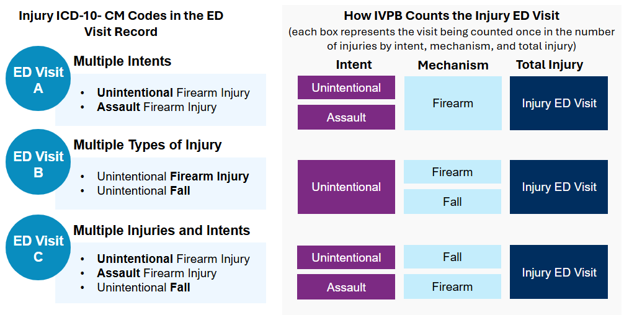
ED Visits with Multiple Firearm injury ICD-10-CM Codes
Some ED visits for firearm injury may receive multiple ICD-10-CM codes related to the firearm injury event, or codes for other types of injuries.
Multiple Firearm injury Intents
- In some cases, there may be multiple codes with conflicting firearm injury intent information, like a code for unintentional firearm injury and another for self-inflicted firearm injury or firearm assault.
- For example, if a patient was holding a firearm when they were shot by someone else (firearm assault), then fell and accidentally shot themselves in the foot (unintentional firearm injury).
- IVPB handles these records differently for ICD-10-CM code-based firearm injury case definitions and for NC-FASTER definitions that also consider key words.
- For ED visits identified with only ICD-10-CM codes, the visit is counted once in each intent category that applies (such as for total firearm assaults or total unintentional firearm injuries), but only once in the total number of firearm injury ED visits.
- For ED visits identified using NC-FASTER definitions, intent defaults to an intentional category (e.g., self-inflicted, assault) if an ED visit includes information for intentional firearm injury and another intent category.
Multiple Injuries Identified
- There may be codes included in a record that describe multiple types of injuries, like firearm injury and a fall.
- A visit with multiple ICD-10-CM codes is counted once in each injury category that applies to that ED visit, but only once in the total number of injury ED visits. For example:
- An ED visit with codes for both an unintentional firearm injury and a firearm assault would be counted one time each in:
- The total number of unintentional injury ED visits
- The total number of assault injury ED visits
- The total number of firearm ED visits
- The total number of injury ED visits
- An ED visit with codes for both an unintentional firearm injury and an unintentional fall would be counted one time each in:
- The total number of unintentional injury ED visits
- The total number of firearm injury ED visits
- The total number of fall injury ED visits
- The total number of injury ED visits
- An ED visit with codes for both an unintentional firearm injury and a firearm assault would be counted one time each in:
Firearm Survey Data
IVPB uses data from the NC Behavioral Risk Factor Surveillance System (BRFSS) and the NC Youth Risk Behavior Survey (YRBS) to better understand and prevent firearm injury.
- Survey data provide insights into firearm ownership, access, and storage behaviors that are useful for firearm injury prevention.
- Questions about firearms may not be included every year that BRFSS and YRBS are implemented.
- For information on the specific questions included in these surveys and when firearm questions were asked, visit:
- Visit Data Sources IVPB Uses for Injury Surveillance for more information on how IVPB uses BRFSS and YRBS data and considerations for using these data.
Considerations For Using Survey Data
Survey data are self-reported and may show different results from what people are actually experiencing. Survey data related to firearms can be affected by:
- Social Desirability Bias – People may report owning fewer or more firearms than they actually do, not having access to firearms when they do, or report storing their firearm differently then they actually do.
- People may not want others to know about their firearm access or ownership.
- People may respond with what they think will make them look good.
- Recall Bias – People may not remember how their firearms are stored during the survey.
- Nonresponse Bias – People may not respond to the survey questions about firearm ownership, access, and storage.
- They may feel uncomfortable and skip the question.
- Some respondents may have stopped participating in the survey before getting to that question.
- They may choose not to participate in the survey at all.
There have been many implications from the COVID-19 pandemic that began in 2020, including changes to the numbers and rates of firearm injuries and deaths.
- Firearm-related deaths have increased since the start of the pandemic.
- There were large impacts to ED visits during the pandemic.
- There was a large drop in the number of people going to the ED for any reason (ED utilization) starting in March 2020 when the COVID-19 stay-at-home order was implemented.
When changes are made to firearm injury surveillance case definitions, those changes are also applied to historical data whenever possible.
- The changes are applied retroactively so that firearm injuries can be counted the same way across multiple years of data.
- Because of this, data IVPB shared before a change was implemented can be different from data shared for the same time-period today.
- Use the data resources posted to the Preventing Firearm Injury and Death webpage to be sure you are accessing the most up-to-date information on firearm injury in NC.
- If you have questions about data you have received from IVPB previously, email us at InjuryData@dhhs.nc.gov.
- Some changes, like those caused by updates to how injury events are coded, cannot be applied to historical data.
Changes in Firearm Injury ED Visit Data
ICD-10-CM Coding Transition
The system used to code diagnoses and other information in ED visit, hospital discharge, and other outpatient data was updated in 2015.
- The codes used previously (ICD-9-CM codes) do not align directly with the new codes (ICD-10-CM codes).
- Since the data are not directly comparable, data from before 2016 usually are not shared.
For more information on this coding transition and impacts to injury surveillance, visit ICD-10-CM Coding Transition.
Changes to ICD-10-CM Coding Guidance for Firearm Injury Intent
The national guidance for coding non-fatal firearm injuries was updated as of Oct. 1, 2025.
- Before Oct. 1, 2025, the intent for all injuries, including firearm-related injuries, defaulted to unintentional injury.
- After Oct. 1, 2025, the intent of firearm injuries defaults to undetermined.
- This change caused the number of unintentional non-fatal firearm injuries to decrease and the number of non-fatal firearm injuries of undetermined intent to increase.
- Data on unintentional firearm injuries and firearm injuries of undetermined intent from before and after Oct. 1, 2025 should not be directly compared.
For more information on updates to firearm injury intent coding and its impacts to firearm-related injury surveillance, visit Differences in Firearm Injuries by Injury Intent.
Interpersonal firearm violence affects some communities more than others. Some of this difference is because of how our society has been built over time.
Long-standing patterns in public policy, investment, and resource distribution have contributed to firearm-related outcomes over many decades.
- These influences have led to differences in firearm ownership and firearm-related injuries among groups of people, including differences by race and ethnicity.
- When interpreting data, it is crucial to keep this historical context in mind and recognize that many contributing factors are preventable and stem from broader systems.
- The language used to describe firearm injuries matters.
- Be thoughtful about how racial and ethnic differences in firearm injuries are described.
- Avoid language that blames victims or communities that are most impacted by firearm violence.
- Often, data about the root cause of firearm injury are not collected alongside health outcome data.
- Special research studies and surveillance initiatives that link datasets and systems, like NC-VDRS, can offer some insights.
The populations and groups impacted by firearm injury are very different than for other causes of Injury.
- Firearm injuries impact younger ages, creating a larger impact on society.
- Firearm injury is a leading cause of death for younger age groups in NC and nationally.
- Firearm injuries result in more years of potential life lost (YPLL) than most other causes of injury.
- Visit Understanding Counts and Rates for more information on YPLL.
- Rates of firearm injuries are highest among young adult males.
- Males are six times more likely to die from firearm violence than females.
- Some racial groups experience a much higher rate of firearm injury.
It is important to look across multiple groups or identities in firearm injury data.
- People’s experience with firearm violence can be influenced by the many parts of who they are, including their sex, age, race, and ethnicity, and where they live, among other factors.
- When looking at firearm-injury data, it is important to also consider demographic factors like sex, age, and race/ethnicity together.
- These factors can overlap and influence how likely someone is to be affected by firearm violence.
- Disaggregating, or breaking out the data out across multiple groups helps to identify patterns and more accurately understand who may be at risk of firearm injury and why.
- For example, residents of rural counties experience higher rates of firearm injury than those of urban counties, and younger black males experience a much higher burden of firearm-related violence than older white females.
- More specific data can help focus prevention efforts.
- Differences in firearm injury between groups also vary by the intent of firearm injury (e.g., suicide, homicide, unintentional injury).
- For more information visit, Differences in Firearm injuries by Injury Intent.
Questions About IVPB Firearm Injury Data
Contact Us
- Email us at InjuryData@dhhs.nc.gov with any questions about IVPB firearm injury data.
Custom Injury Data Requests
- Visit the custom injury data request page for more information on how to request overdose data from IVPB.
Epidemiology Office Hours
- Schedule time to meet with an epidemiologist to discuss data availability, questions or custom requests.
- Visit the custom injury data request page for more details.
Firearm Injury Prevention Information
Information, resources and tools that people and communities can use to support firearm injury prevention can also be found at:
NC IVPB Firearm Safety Awareness and Education – Information on firearm safe storage and the NC Safe Storage Law.
- Keeping Families and Communities Safe: Public Health Approaches to Reduce Violence and Firearm Misuse Leading to Injury and Death – A report outlining public health actions to reduce firearm injury and death and increase community and family safety from firearm violence and misuse.
- Recommendations on Firearm Safety for Suicide Prevention
- NC S.A.F.E. – Firearm safe storage information and resources.
- NC Office of Violence Prevention
For more resources, visit our Injury Data Users Toolkit.