
Understanding Fall Injury Data
Summary of Fall Injury Data
The Injury and Violence Prevention Branch (IVPB) creates multiple resources to help keep our partners informed about fall injuries in NC.
Visit our Fall Injury Data page for annual surveillance updates, statewide summary data and county-level data on unintentional fall injuries. This page includes:
- Summary information on fall injury deaths, hospitalizations and emergency department (ED) visits in NC over time
- Data on groups most impacted by fall injury
- County-level data on fall injuries and deaths, including data on traumatic brain injury (TBI)-related fall injuries
- Other fall injury data resources and links to fall prevention information
Additional data about how unintentional fall injuries compare to other leading causes of injury are also included on the IVPB Data and Surveillance page.
For help finding the injury data you need, visit the NCDHHS Injury and Violence Prevention Data Resource Inventory. This interactive tool helps you identify which website or IVPB data resource has the information that best meets your needs.
IVPB creates and shares these resources to support fall injury prevention across NC.

- Permission is not needed to use any of the posted data in your presentations, manuscripts, reports and other work.
If you use IVPB published data, please include a version of the following citation:
NC Department of Health and Human Services, Division of Public Health, Injury & Violence Prevention Branch. ‘[data resource name].“ [webpage data were accessed from]. Accessed [insert access date]. [insert the website address].
Below is a brief summary of each resource.
Fall Injury Data Resources
Use the prepared PowerPoint slides to include unintentional fall injury data in your next presentation, or as a resource to understand more about fall injuries in NC.
There are two sets of prepared slides.
Fall-Related Injuries Slide Set
- PowerPoint presentation providing an overview of some of the key unintentional fall injury trends in NC.
- Includes information on statewide vulnerable populations, unintentional fall deaths and unintentional fall injury hospitalizations and ED visits.
Older Adult Falls and Related TBI
- PowerPoint presentation including a data overview, prevention strategies, and statewide resources for older adult falls and TBI.
- There is also a recording of this Older Adult Falls and Related TBI presentation.
These slides can be used to:
- Understand which groups are most impacted by unintentional fall injuries, where unintentional fall injuries are occurring and how the number of these injuries has changed over time in NC.
- These PowerPoint slides are meant to offer a state-level background on fall injuries by data source.
- Slides include information on unintentional fall injury deaths, hospitalizations and ED visits, with specific data for older adults.
- The slides were created to provide basic data trends and
around unintentional fall injuries.
Incorporate fall injury data into your own presentations, grant proposals, reports, or any other way they may be useful.- Each slide includes detailed notes explaining the information on the slide.
- Technical notes are also available to help with understanding and presenting data.
Traumatic Brian Injury (TBI) is an injury caused by a bump, blow, jolt or penetration to the head that disrupts the normal function of the brain. TBI is a common condition surrounding fall injuries, with many fall injuries resulting in a TBI.
Use these maps of TBI-related fall injuries to compare rates of unintentional fall injuries and deaths that also involved TBI across NC counties.
- Know where TBI-related fall injuries are happening in the state.
- Compare rates of TBI-related fall injuries by county. For more information on comparing injury rates, visit Understanding Counts and Rates.
- Focus prevention and response activities to areas of the state that are most impacted by fall injuries and TBI.
- Maps include data over the most recent five-year period.
- Maps are available for TBI related fall injury deaths, hospitalizations and ED visits.
Use the Unintentional Falls ORION Reports to compare the number and rate of unintentional fall injuries and deaths across different demographic groups.
- Reports include data for unintentional fall injury deaths, hospitalizations and ED visits by gender, race/ethnicity and age group.
- Data can be used to focus prevention and response activities to groups that are most impacted by unintentional fall injuries.
- Reports are available statewide and by county, with data over the most recent five-year period.
- For county-specific reports, select the county from the dropdown list and then select “Get County Report.”
Use the Fall Injuries Special Emphasis Report for more detailed data about unintentional fall injuries among older adults.
- Describes the impact and magnitude of falls in older adults.
- Outlines risk factors for falls in older adults and compares fall injury data among older adults by age group, sex and for counties experiencing the highest hospitalization rates for unintentional falls.
- Provides data on circumstances of the fall injury, including hip fractures and TBI.
- Includes strategies for prevention of falls in older adults and ongoing fall injury prevention strategies taking place in NC.
Use the leading causes of injury data resources to compare unintentional fall injuries and deaths to other leading causes of injury and death in NC.
These resources provide data on the top five or top 10 leading causes of injury ED visits, hospitalizations and deaths in NC and by county.
Leading Causes of Injury in NC PowerPoint slides
- These PowerPoint slides provide a state-level overview of the leading causes of injury death, hospitalizations and ED visits for NC residents.
- Slides include data for the most recent finalized data year.
- Slides can be used to incorporate fall injury data into your own presentations, grant proposals, reports or any other way they may be useful.
- Each slide includes detailed notes to help with understanding and presenting leading causes of injury data.
Top Five Leading Causes of Injury by County Reports
- Reports provide data on the top five leading causes of injury deaths, hospitalizations and ED visits by county overall and for specific age groups.
- Data included in the reports are combined over the most recent five years.
Statewide Leading Causes of Injury Charts and Tables
- Charts show the top 10 leading causes of injuries for each age group.
- Leading causes are further grouped by injury intent. For more information on injury intent, visit Injury Mechanism and Intent.
- Tables show the count and rate for the top 10 leading causes of injury.
- Tables are included by age group, race/ethnicity and sex.
- Charts and tables include data for the most recent finalized data year.
- Reports for previous data years are also available.
Injury Mechanisms and Intent ORION Reports
- Statewide reports are available for the most recent finalized data year.
- Reports for previous data years are also available.
- Reports compare counts and rates of all types of injury mechanisms and intents.
- Statewide and county-specific reports combine the most recent five years of data.
- Combining data across multiple years allows data to be shared for all counties. For more information visit, Data Suppression and Working with Small Numbers.
- For county-specific reports, select the county from each of the dropdown lists and select “Get County Report.”
Use the NC DETECT Unintentional Falls Dashboard to track and monitor annual ED visit trends for unintentional fall injury statewide and by county over time.
- Data can be compared by sex, race, age group and county to identify groups experiencing the greatest burden of unintentional fall injury across the state and focus prevention activities.
- Data are available overall and for older adults.
- The dashboard includes data from 2017 forward.
- The most recent year of data included in the dashboard may be provisional and subject to change.
- For more information on provisional ED visit data, visit Using Provisional Data for Monitoring Injuries.
- Each page of the dashboard can be downloaded as a PDF or as other formats.
Use NC BRFSS data from the NC State Center for Health Statistics (SCHS) to understand self-reported experiences with falls and fall-related injury.
- Questions included in the survey alternate from year to year and may change over time.
- The NC SCHS provides all questionnaires and survey results from the NC BRFSS on the NC BRFSS website.
- For more information on considerations when using survey data to understand fall injuries, visit What Should I Know Before Using Fall Injury Data.
- For more information about NC BRFSS data, visit Data Sources IVPB Uses for Injury Surveillance.
What Should I Know Before Using Fall Injury Data?
IVPB fall injury data can be used in many ways, from:
- Identifying risks
- Tracking trends
- Developing effective prevention strategies
- Supporting advocacy, funding decisions and public awareness campaigns
This document outlines what you should know and consider before using firearm injury data included in IVPB fall injury data resources.
Data Considerations
Who Is Included in Fall Injury Data?
Fall injury data are limited to NC residents.
Residence describes the area where someone has reported that they live.
- Limiting to residents allows for rate calculations using NC resident population estimates.
- This ensures that the information used to calculate rates is consistent.
- Limiting to residents allows for more accurate comparisons across groups and between counties.
- This excludes people that were injured or died from a fall in a given county but are not residents of that county.
- Someone living in a county, but who has not yet updated their residence status to that county would also be excluded.
Differences in Injury Location and Residence
Where a fall injury occurs or where a fall injury is treated can be different from where a person lives.
- This distinction is especially true in rural areas where a single hospital or health care facility may serve a large area across multiple counties.
- Someone may experience a fall injury in one county and then be transported to and treated in a hospital in another county.
- This transfer of care to another county is common for people with serious injuries that require treatment at a designated trauma center.
- This difference is not shown in the IVPB fall injury data because these data are normally based on residence rather than injury location.
For more information, visit Understanding Injury Surveillance Case Definitions.
Fall Injuries Among Older Adults
While IVPB fall injury data are available for all NC residents, many resources are specific to fall injuries among older adults ages 65 and older.
- Older adults experience the greatest burden of fall injuries and deaths, with rates of fall injuries and death being highest among adults 85 and older.
- IVPB provides more specific data on the demographic groups and places where there is a greater burden of fall injuries among older adults.
- These data can help focus prevention activities for older adults.
What Is Counted in Fall Injury Data?
IVPB fall injury data are limited to unintentional fall injuries.
- Assaults, self-inflicted fall injuries and injuries of undetermined intent are excluded.
- Almost all fall injuries and deaths (around 99%) are unintentional injuries.
- For more information on intent, visit Injury Mechanism and Intent.
IVPB monitors fall injuries that are treated in a hospital setting or that result in death.
Non-fatal fall injury data do not capture:
- Unintentional fall injuries treated outside of the ED or hospital.
- This can include fall injuries treated at urgent care clinics, by primary care providers or by other health care providers.
- Fall injuries where someone does not seek medical care or that are treated at home.
- While data are not available to show exactly how many of these falls occur, IVPB does use survey data to understand how many people report experiencing falls.
What Else is Measured to Monitor Fall Injuries?
Other Health Outcomes Related to Falls
In addition to how many people died from or experienced an unintentional fall injury, IVPB also monitors fall injuries and deaths that involved:
- Traumatic brain injury (TBI)
- Falls lead to almost half of TBI-related injury hospitalizations.1
- Hip fractures
- More than 80% of hip fractures treated in the ED or hospital are caused by a fall.2
- Hip fractures are hard to recover from. Many people do not regain their same level of function from before the injury and may not be able to live on their own.2
Self-Reported Fall Injuries
Fall injuries seen in the ED or in the hospital are only the tip of the iceberg. Many more falls happen where people do not seek medical attention or are seen by providers outside of the ED or hospital.
- IVPB uses self-reported data from the NC BRFSS to understand the broader impact of fall injuries.
- Visit NC State Center for Health Statistics, BRFSS for information on BRFSS.
No single data source captures the full scope of fall injury in NC. Data sources should be used together to more fully understand the statewide impact of fall injuries and related health outcomes.
For more information on a specific data source, visit Data Sources IVPB Uses for Injury Surveillance.
Fall Injury Death Data
IVPB uses vital statistics death certificate data to monitor fall injury deaths.
- Unintentional fall injury deaths are limited to deaths where the fall was the primary cause of death.
- Primary causes of death are the injuries or conditions that directly resulted in the death.
- Deaths from other primary causes that have unintentional fall listed as an underlying cause of death are not included.
- An underlying cause of death is an injury or condition that started the chain of events that directly or indirectly led to the primary cause of death.
- There are only a handful of deaths each year with unintentional fall listed as an underlying cause.
- Fall injury deaths are identified in the death certificate data using ICD-10 codes.
- For more information, visit Understanding Injury Surveillance Case Definitions.
Fall Injury Hospital Discharge Data
Hospital discharge data are encounter-based, meaning that the same person may have multiple hospital stays during any given time period.
Identifying Unintentional Fall Injury Hospitalizations
- ICD-10-CM codes are used to group and classify diagnoses and reasons for health care visits in administrative health care systems, including hospital discharge data.
- ICD-10-CM codes are intended for administrative and billing purposes, not
.
- This purpose can affect which codes are or are not assigned to a record and therefore which events are included or excluded as fall injury cases.
- For more information on ICD-10-CM codes, visit Understanding Injury Surveillance Case Definitions.
- ICD-10-CM codes are intended for administrative and billing purposes, not
.
- IVPB includes hospital records as unintentional fall injury hospitalizations when there is an ICD-10-CM code for any injury listed as the primary diagnosis, and an unintentional fall injury ICD-10-CM code listed anywhere in the record.
- Records with another non-injury ICD-10-CM code listed as the primary cause are excluded, even if there is also a code for a fall injury later in the record.
- IVPB does not exclude hospitalizations that result in death.
- Including hospitalizations resulting in death helps to understand the full burden of unintentional falls and other injuries on the NC health care system.
- IVPB’s expanded case definition can contribute to differences in the number of unintentional fall injury hospitalizations IVPB identifies compared to those shared by CDC or other sources.
- For more detailed information on how these cases are identified, see Injury Surveillance Technical Notes.
Identifying falls involving TBI or Hip Fracture
These are hospitalizations that meet the definition above (an injury code as the primary diagnosis and a code for unintentional fall injury included in the record), that also include:
- TBI-related fall hospitalizations - an ICD-10-CM code for TBI listed anywhere in the record.
- Fall-related hip fracture hospitalizations - an ICD-10-CM code for hip fracture listed anywhere in the record.
Costs of Fall Injury Hospitalizations
Hospital discharge data include information on the total charges billed for the hospital stay.
- This information can be used to understand the financial costs of fall injury hospitalizations.
- The total charges billed are not necessarily the same amount that was paid for the hospital visit.
- Insurance companies typically negotiate to lower rates for hospital charges.
Fall Injury ED Visit Data
ED visit data are also encounter-based. The same person may have multiple ED visits during any given time period.
Data Quality
- Trends may be impacted by missing data.
- There were changes in the number of people going to the ED for any reason (ED utilization) during the COVID-19 pandemic.
Identifying Unintentional Fall Injury ED Visits
ICD-10-CM codes are used to identify ED visits for unintentional fall injuries. For more information, visit Understanding Injury Surveillance Case Definitions.
- ED visits with an ICD-10-CM code for an unintentional fall injury anywhere in the record are included.
- IVPB does not exclude ED visits where the patient is admitted to the hospital or that result in death.
- Some ED visit case definitions, called syndromes, also search the chief complaint and/or triage notes fields for keywords to identify fall injury ED visits.
- NC DETECT uses a syndrome to identify winter weather-related ED visits, including falls from snow and ice.
- Because these definitions also use keywords, they identify more ED visits than when using ICD-10-CM codes alone.
- For more detailed information on how these cases are identified, see Injury Surveillance Technical Notes.
ED Visits with Multiple ICD-10-CM Codes
Some unintentional fall injury ED visits may receive multiple ICD-10-CM codes related to the fall injury and for other types of injury.
- There may be codes to describe multiple types of injuries, for example a fall and a cut/pierce injury.
- In some instances, there may be multiple injury codes with conflicting intent information, such as a code for an unintentional fall injury in addition to a code for self-inflicted injury.
- The ICD-10-CM coding guidance defaults to classifying injuries as unintentional.
- Multiple codes may be used to document different aspects of the ED visit, which can contribute to conflicting or inconsistent coding.
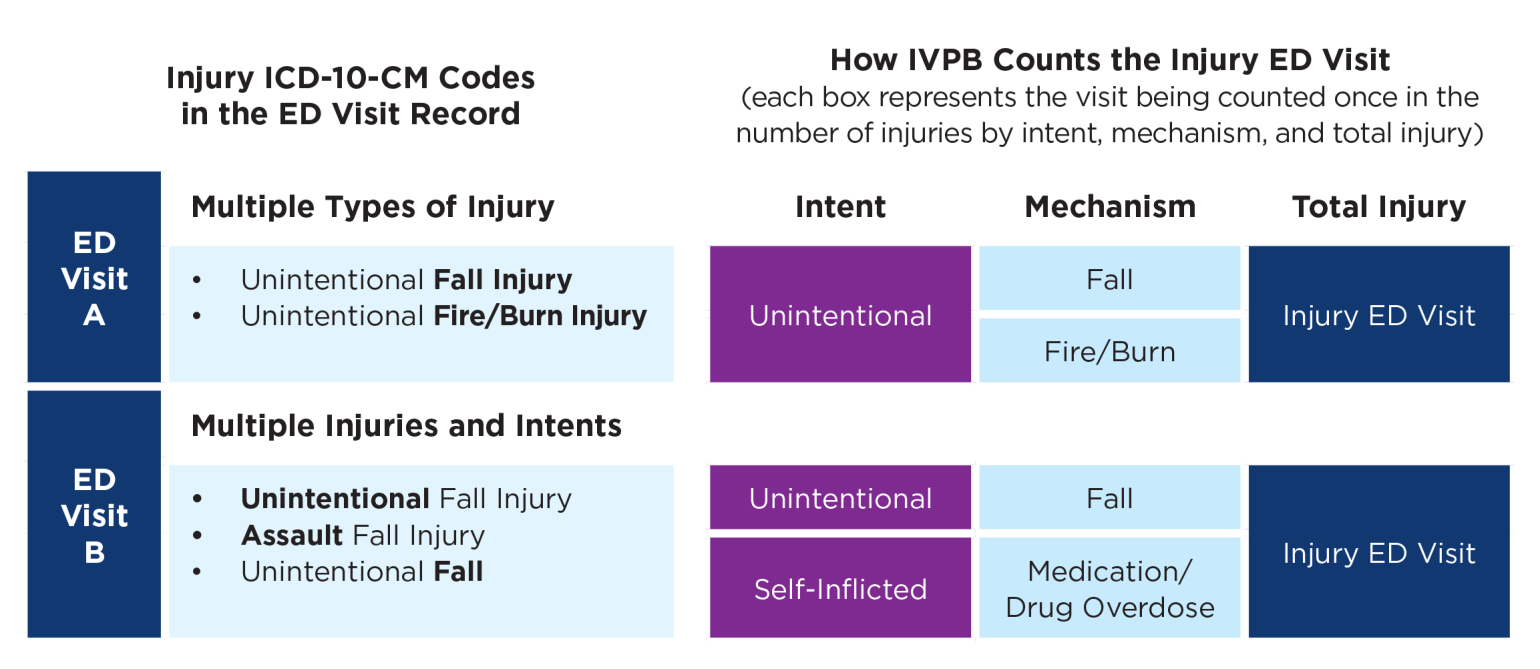
A visit with multiple ICD-10-CM codes is counted once in each mechanism and intent category that applies to that ED visit, but only once in the total number of injury ED visits.
For example:
- An ED visit that had a code for both an unintentional fall and an unintentional burn would be counted one time each in:
- The total number of unintentional injury ED visits
- The total number of unintentional fall ED visits
- The total number of unintentional fire/burn ED visits
- The total number of injury ED visits
- Similarly, if multiple types of injuries were identified, that had different mechanism and intent categories, such as a code for both an unintentional fall injury and a self-inflicted overdose, it would be counted once in each category:
- The total number of unintentional injury ED visits
- The total number of self-inflicted injury ED visits
- The total number of unintentional fall injury ED visits
- The total number of overdose ED visits
- The total number of injury ED visits
Emergency Medical Services (EMS) Data
- EMS data are useful for identifying the broader impact from falls when the fall doesn’t require medical attention in the ED or hospital.
- EMS data include EMS responses where the patient is treated on-scene and not transported to the hospital, as well as those that are transported.
- Falls that are treated on the scene and not transported are often falls among older adults, where someone needs assistance getting back into bed or to another safe place but does not require further medical attention.
- Fields in the EMS data describe the chief complaint, symptoms, impressions, causes of injury and notes outlining the response.
- Syndrome definitions search these fields using keywords to identify related-EMS responses.
- EMS responses for falls offer opportunities for prevention.
- First responders are often responding to the home and can help identify and address fall risks with patients.
- EMS data are also encounter-based. The same person may be involved in multiple EMS responses during any given time period.
Survey Data
IVPB uses data from the NC BRFSS to better understand the burden of falls and related injuries in NC.
- The NC BRFSS surveys adults living in NC about behaviors and experiences that impact their health, including:
- How many times someone has fallen over the last year
- How many of those falls resulted in an injury that limited their activity or caused them to see a doctor
- NC BRFSS data on falls provide more context on the burden of fall injury among NC adults and can be used to understand connections to other health behaviors, and risk and protective factors.
- Visit Data Sources IVPB Uses for Injury Surveillance for more information on how IVPB uses NC BRFSS data.
Survey data are self-reported and may show different rates of falls than what people actually experienced. Survey data related to falls can be affected by:
- Social Desirability Bias – People may report experiencing fewer falls than they actually do or may report not experiencing them at all when they have fallen.
- People may be embarrassed by or not want others to know about their health issues.
- People may respond with what they think will make them look good.
- Recall Bias – People may forget exactly how often over the reporting period they experienced a fall.
- Nonresponse Bias – People may not respond to the survey questions about falling.
- They may feel uncomfortable and skip the question.
- Some respondents may have stopped taking the survey before getting to that question.
- They may choose not to participate in the survey at all.
Unintentional fall injury case definitions have not changed much over the years.
If changes are made, they are also applied to historical data whenever possible.
- Changes are applied retroactively so that data can be counted the same way across multiple years of data.
- This allows IVPB to accurately monitor trends.
- Because of this, data IVPB shared before a change was implemented can be different from data shared for the same time period today.
- Use the data resources posted to the Fall Injury Data webpage to be sure you are accessing the most up-to-date information on fall injuries in NC.
- If you have questions about data you have received from IVPB previously, email us at InjuryData@dhhs.nc.gov.
There have been many implications from the COVID-19 pandemic that began in 2020, including major changes to the numbers and rates of unintentional fall injuries.
- Unintentional fall injury deaths were already increasing and continued to increase during the pandemic.
- There were large impacts to ED visits during the pandemic
- There was a large drop in the number of people going to the ED for any reason (ED utilization) starting in March 2020 when the COVID-19 Stay at Home Order was implemented.
- The number of ED visits for unintentional falls had been decreasing before the pandemic. Since 2020, there has been more than a 40% increase in ED visits for unintentional fall injuries have been increasing. (2020 to 2023).
- ED visits for related health outcomes, such as TBI, also increased during the pandemic.
- Changes to unintentional fall injuries in NC align with trends seen across the United States during the pandemic.
Who we count — and how — changes what we know about self-inflicted injury.
The most reliable way to collect information on race and ethnicity is when it is self-reported, where individuals choose the race and ethnicity they use to describe themselves.
Asking someone to report their own race and ethnicity ensures the data are accurate.
- In some cases, race and ethnicity may not be self-reported and may instead be assigned based on someone’s name or their appearance.
- This assumption may happen if the person was unresponsive when EMS responded or when they arrived at the ED.
- This assumption can result in misclassification of race and ethnicity, when someone is categorized into a racial or ethnic group that they do not identify with.
For more information on how race and ethnicity are collected in the data sources IVPB uses, and how IVPB groups race and ethnicity, visit Using Injury Data by Race and Ethnicity.
Monitoring Fall Injuries by Demographic Groups
IVPB uses rates to compare the burden of fall injury across groups, including by age group, sex and race/ethnicity.
- This approach allows IVPB to identify groups that are experiencing the greatest burden of fall injury (e.g., older adults).
- IVPB regularly breaks out data separately for older adults, to consider differences in fall injuries among older adults by sex, race and county.
- Rates account for the size of the population and allow us to compare injuries that happened in small populations to injuries in larger groups.
- Comparing rates helps us understand differences in unintentional fall injuries between groups.
- For more information, visit Understanding Counts and Rates.
- When data are broken out for specific groups, results may need to be suppressed if there are very few fall injuries within a given group.
- When the number of injuries or deaths is small, it becomes difficult to separate data further to understand more specifically who was impacted.
- Visit Data Suppression and Working with Small Numbers.
Questions About IVPB Fall Injury Data
Contact Us
- Email us at InjuryData@dhhs.nc.gov with any questions about IVPB fall injury data.
Custom Injury Data Requests
- Visit the custom injury data request page for more information on how to request fall injury data from IVPB.
Epidemiology Office Hours
- Schedule time to meet with an epidemiologist to discuss data availability, questions or custom requests.
- Visit the custom injury data request page for more details.
Fall Injury Prevention Information
- Information about fall injury prevention is available on the IVPB Falls Injury page.
- Visit Standing Strong NC for steps to prevent falls and related injuries.
- Includes a wide range of information, tools, and resources aimed at preventing falls among those ages 55 and older
- Visit the NC Falls Prevention Coalition website to learn about efforts to reduce the number of injuries and deaths from falls among adults in NC.
- Access the Falls State Action Plan for more information on falls prevention in NC.
- Learn about efforts to:
- Increase awareness
- Provide education and training
- Provide tools and resources
- Foster linkages between programs and organizations working to reduce falls
- Visit Safe Kids North Carolina for information on falls safety, playground safety, and other resources to prevent injuries among children.
- For national data and prevention resources, visit:
For more resources, visit our Injury Data Users Toolkit.