
Preventing Suicide and Self-Inflicted Injury
North Carolinians die every day from suicide
Leading cause of death for youth
Leading cause of death for ages 19-34
of people who survive do not go on to die by suicide
You Are Not Alone
If you or someone you know is thinking about suicide, visit 988 Lifeline, call 988 or text 988 (for Spanish: text AYUDA to 988).
The 988 Lifeline is available 24/7/365. Your conversations are free and private.
- Call 988 or (800) 273-8255
- For the Veterans Crisis Line, press 1.
- For support in Spanish, press 2. (Para español, oprima dos.)
- Everyone else, stay on the line or press 0. You will be connected with a caring and qualified counselor ready to support you.
- For the Veterans Crisis Line, press 1.
- Text 988 (for Spanish: text AYUDA to 988)
- Chat online
- Get help if you are deaf, hard of hearing, or have hearing loss
Suicide is the act of intentionally taking one’s life. Suicide is a serious public health problem that can have long-lasting effects on people, families and communities. Suicide deaths are only part of the problem. More people survive suicide attempts than those who die, and they are often seriously injured and need medical care.
Suicides can be prevented by:
- Recognizing signs and symptoms
- Learning how to help
- Taking steps to provide help to people of all ages and abilities in need
What are the Risk Factors for Suicide?
A combination of situations can contribute to the development of suicidal thinking. This is especially true if someone is experiencing a crisis.
Risk factors can increase the likelihood of suicide but may not be a direct cause. Risk factors for suicide include, but are not limited to:
Individual
- Previous suicide attempt
- Mental illness such as depression
- Substance use disorder
- Job problems or loss
- Impulsive or aggressive tendencies
- Serious illness such as chronic pain
- Sense of hopelessness
Relationship
- Adverse childhood experiences, such as child abuse and neglect
- Bullying
- Family history of suicide
- Sexual violence
- Intimate partner problem
- Social isolation
Community
- Barriers to accessing health care
- Suicide cluster in the community
- Community violence
Societal
- Stigma associated with mental illness or help-seeking
- Easy access to lethal means among people
at risk (e.g., firearms, medications)
More information: CDC's Suicide Prevention page
North Carolina Comprehensive Suicide Prevention Program
Our Comprehensive Suicide Prevention (CSP) program focuses on reaching those most at risk for suicide. In North Carolina, that includes men, veterans, those residing in rural communities and youth ages 10-18.
Our evidence-informed programs/practices include:
- Firearm Safety Teams – Expanding and disseminating Firearm Safety Team (FST) development training across the state.
- Injury-Free NC Academy – Providing training to introduce evidence-based suicide prevention policies and programming.
- Counseling on Access to Lethal Means (CALM) – Providing various CALM sessions to expand access to lethal means counseling.
- Community Helper Training – Promoting gatekeeper trainings through Living Works Start, Applied Suicide Intervention Skills Training and Living Works Faith.
- Suicide Prevention in Schools – Collaborating with Department of Public Instruction to create and implement online training modules for Suicide Prevention Training in NC schools.
CSP Program Offerings
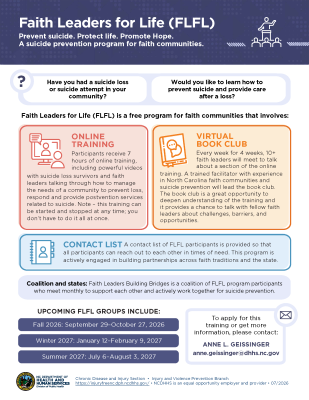
This program connects online training with facilitated discussion for faith leaders to build skills in managing needs of a community to prevent loss, to respond and to provide support after suicide loss. Participants will learn active skills for identifying people in crisis and referring them to care. This program requires a four-week commitment to attend one virtual meeting a week.
If interested, please contact Anne L. Geissinger.
This training is for individuals that may interact with veterans at work, at home, the gym, or anywhere else. SWV is a free 90-minute virtual training that teaches individuals how to talk to people about suicidal thoughts instead of staying quiet and wondering if someone is okay. This training provides the skills and confidence to ask the question and connect Veterans to helpful resources.
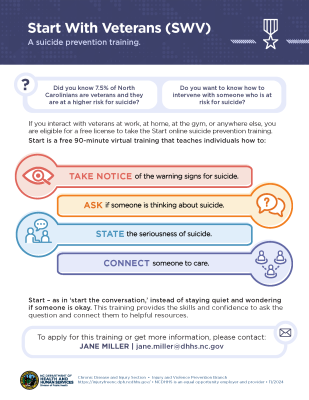
If interested, please contact Jane Ann Miller.
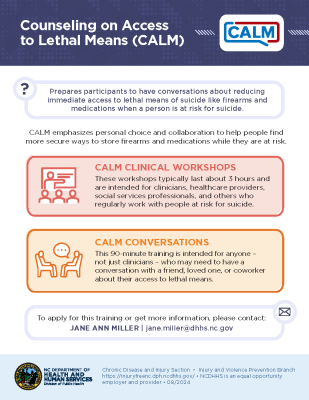
This free training prepares participants to have conversations about reducing immediate access to lethal means of suicide like firearms and medications when a person is at risk for suicide.
There are two versions:
- 90 minutes (for everyone)
- Three hours (for clinicians, health care providers, social services professionals, and others who regularly work with people at risk of suicide)
If interested, please contact Jane Ann Miller.
This is a two-day, interactive workshop in suicide first aid. ASIST teaches participants to recognize and intervene when someone is having thoughts of suicide.
Participants don’t need formal training to attend. ASIST can be learned and used by any adult.
Continuing Education Credits (CEUs) are available.
If interested, please contact Megan Lueck.
For an overview of all programs offered, visit Overview of Suicide Prevention Trainings.
Needs Assessment Tool for Suicide and Related Outcomes
Suicide affects all communities in North Carolina.
The NC Comprehensive Suicide Prevention (CSP) team developed this needs assessment tool using suicide-related data to help identify which North Carolina communities may need extra support from focused suicide-related prevention and intervention strategies.
An assessment score for each North Carolina county is compared to the state score. If a county received a score higher than the state score, it is considered at higher need for suicide and related outcomes. Counties with higher need may require more resources and support for prevention and intervention services.
These data can be used to inform public health action to reduce and prevent suicide. This tool does not assess a county's capacity or ability to implement suicide prevention and intervention strategies. Communities may also want to work with other local data, existing programs and partnerships, and known areas of increased need when deciding on prevention approaches that best fit their communities. No matter the assessment score, suicide affects all communities. Together with local and state partners, CSP's goal is to support all communities in their efforts to reduce the harms connected with suicide as resources allow.
Learn about the indicators used and how each county is scored in the Methodology document.
Statewide Inventory of Suicide Prevention Efforts
This map helps communities identify prevention efforts in their area.
- To navigate the map, use the filter sections underneath the map according to the safe storage methods or special populations that are of interest.
- Provides Safe Storage for Firearms and Provides Safe Storage for Medications allow you to filter resources throughout the state by which type of safe storage practice an organization may offer.
- The Populations Served check boxes allow you to filter resources throughout the state by the priority populations they serve.
- The map legend provides a color-coded system for resources based on the priority populations which are served by that resource.
- To select a resource, hover your cursor over the resource to read what the resource is, where they are located, what services they provide, and what counties they serve.
- If you wish to view the resource you have selected in a more in-depth manner, click on the resource on the map and you will be directed to the website for that resource.
- Zoom in or out of areas on the map by using the map tool on the left-hand side of the map.
Suicide Prevention Resources
- The North Carolina Suicide Prevention State Action Plan is a coordinated, evidence-based initiative to reduce suicide deaths and self-harm.
- The Suicide Prevention Resource for Action is CDC guidance for evidence-based suicide prevention.
- The North Carolina Recommendations on Firearm Safety for Suicide Prevention is a 2020 addition to the suicide prevention strategic plan focused on firearms.
- The CDC Suicide Prevention Page provides an overview of suicide prevention, risk factors, impacts, and ways to get help and support.
- The NCDHHS Suicide Prevention Resources page provides prevention resources for suicide prevention.
- The CDC Suicide Prevention Playbook gives you a step-by-step guide to develop suicide prevention communication campaigns that contribute to behavior change.
- Self-Inflicted Injury ED Visit Surveillance Report is a quarterly report with trends and demographic breakdowns of ED visits for self-inflicted injury in NC.
- Population-Specific Fact Sheets are NC-VDRS fact sheets on suicide deaths among males, veterans, youth, older adults, and rural populations.
- NC-VDRS Annual Report is a detailed summary of violent deaths including suicides and violent deaths involving firearms.
- Self-Inflicted Drug Poisonings Among North Carolina Youth, 2020-2024 is a fact sheet that outlines self-inflicted drug poisonings among youth from 2020-2024.
- Bullying in North Carolina provides insights from the NC Youth Risk Behavior Survey (NC YRBS).
- Self-inflicted Injury and Death in North Carolina, 2024 is a fact sheet that outlines the burden of self-inflicted injury and suicide death among North Carolina residents. Updated 10/5/2026
- Suicide and Self-inflicted Injury Death and Morbidity in North Carolina, 2024 is a PowerPoint presentation with data on suicide and self-harm deaths, hospitalizations, and ED visits in NC.
- After a Suicide: A Toolkit for Schools is a resource created by the Suicide Prevention Resource Center, Education Development Center, and American Foundation for Suicide Prevention to support schools after a loss.
- Postvention in Higher Education is a Jed Foundation guide for response to suicide on college campuses.
- Best Practices and Recommendations for Reporting on Suicide provides guidelines for media reporting on suicide.
- American Foundation for Suicide Prevention (Hope and Healing webpage) is a webpage by the American Foundation for Suicide Prevention to support individuals after a suicide loss.
- People Matter, Words Matter is a guide for talking about suicide using destigmatizing language that promotes help-seeking.
- North Carolina Violent Death Reporting System Data Dashboard where you can query and visualize data on overall violent deaths, homicides, suicides, and firearm-related deaths statewide and by county.
- NC DETECT Mental Health Dashboard where you can view zip code, county, and state-level ED visit trends for select mental health-related conditions.